What Is Shadow Work? A Complete Guide by India's Only IPHM Accredited Shadow Work Expert
“Aditi Nirvaan, India's Only IPHM Accredited Shadow Work Expert, explains what shadow work really is, how it differs from therapy and journaling, and why it is the most direct path to lasting inner change.”
What Shadow Work Actually Is — And Why So Many Patterns Still Keep Repeating
You have done the therapy. You have journaled. You have meditated. You have read the books, attended the workshops, listened to the podcasts.
And still.
The same argument keeps happening in your closest relationship.
The same financial ceiling keeps appearing.
The same creative block returns the moment you try to move forward.
This is not a failure of effort.
It is a signal that something deeper has not been touched yet.
That something is your shadow.
What Shadow Work Actually Is
Shadow work is the process of identifying, acknowledging, and integrating the parts of yourself that you have hidden, suppressed, denied, or disowned.
Not because you chose to, but because at some point in your life, those parts felt too dangerous, too shameful, or too painful to show.
The term comes from Carl Gustav Jung, the Swiss psychiatrist who described the shadow as the unconscious part of the personality that the conscious ego does not identify with.
In Jungian psychology, the shadow is not inherently negative.
It is simply the part of you that was pushed underground.
What most introductions to shadow work miss is this:
The shadow is not just a psychological concept.
It is a living pattern in your body, your relationships, your bank account, and your health.
It shows up as the emotion you cannot name, the reaction that surprises even you, the recurring situation you cannot seem to escape no matter how much you understand about it intellectually.
Shadow Work Through an Indian Lens
The concept of the shadow is not foreign to the Indian psyche at all.
It is woven into our oldest stories.
In the Mahabharata, Karna's shadow — his wound of illegitimacy and his need for recognition — drove every decision he made, even when it cost him everything.
Draupadi's shadow of rage and humiliation shaped the arc of an entire war.
Shiva's cremation ground is not a symbol of death.
It is a symbol of willingness to sit with what has been discarded, what has been pushed out of the acceptable world and left in the dark.
Indian mythology has always understood that wholeness comes not from eliminating darkness but from integrating it.
Carl Jung himself acknowledged the influence of Indian philosophy on his understanding of the psyche.
Shadow work, at its deepest level, is the modern clinical name for something the Indian tradition has been pointing toward for millennia.
Why Shadow Work Is Everywhere in India Right Now — And What That Misses
Vogue India has featured shadow work journaling prompts.
Elle India has covered shadow journaling as the self-care trend people are finally brave enough to try.
The Indian Express called it one of the most significant new mental health trends.
And here is the thing most of these cultural moments miss entirely:
Shadow work journaling is not shadow work.
Journaling prompts are a doorway.
They can help you begin to see what is there.
But the shadow — the part of you that has been operating in the unconscious for years or decades — does not yield to a journal prompt.
It yields to a structured, held, expert-guided process that meets it at the level where it actually lives:
- In the nervous system
- In the body
- In the unconscious patterns running below conscious awareness
That distinction matters more than almost anything else in this field.
And most of what is currently circulating under the name of shadow work does not make it.
What the Shadow Actually Looks Like in Your Life
The shadow shows up in recognisable ways, and you will likely find yourself in at least some of these.
Projection is one of the most consistent signs.
You see in others what you cannot acknowledge in yourself.
The colleague whose confidence irritates you in a way that feels slightly disproportionate.
The friend whose success triggers something you cannot quite name.
Repetition loops are another.
The same relationship dynamic playing out with different people across different decades.
The same kind of conflict with authority.
The same emotional withdrawal at the moment of genuine intimacy.
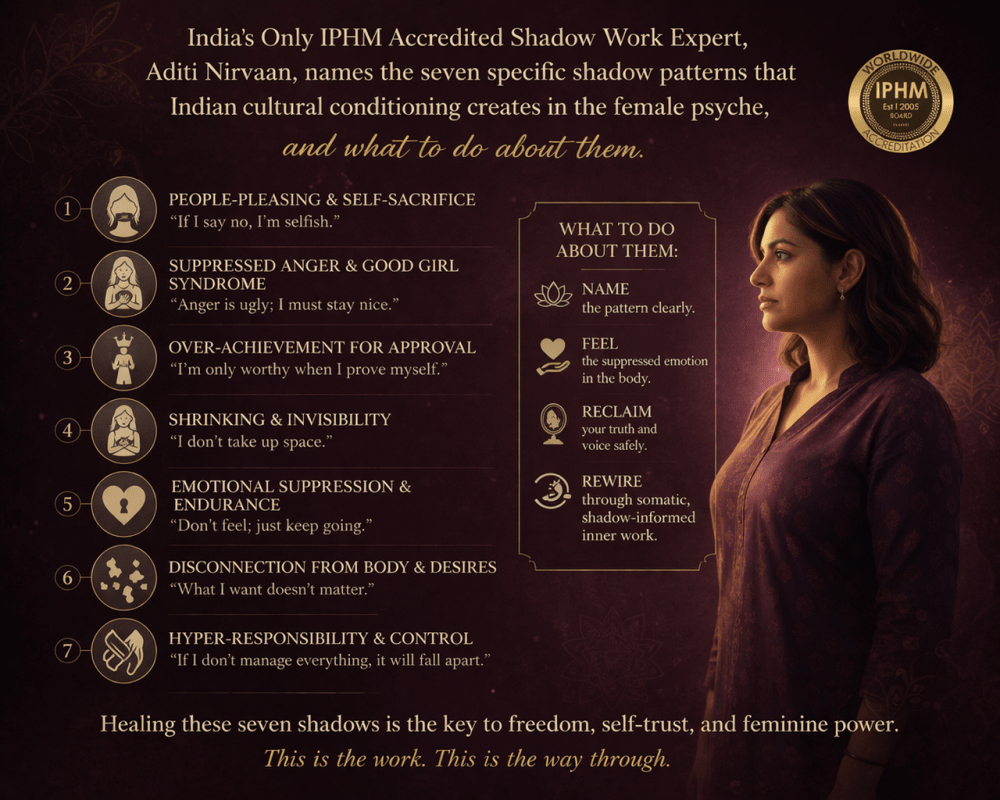
Perfectionism, procrastination, and people-pleasing are shadow patterns, not personality traits.
They are rooted in early wounds around worthiness, safety, and visibility.
They do not resolve through willpower or better habits.
The glass ceiling with no external explanation is a shadow pattern.
When the skill set is in place, the network is strong, the strategy is solid — but something invisible keeps pulling back at the threshold of the next level.
And chronic dysregulation:
- Anxiety that does not go away
- A body that braces even in safe environments
- Sleep that never quite restores
- A baseline of low-grade vigilance that has become so familiar it feels like your personality
These are shadow communications, not character flaws.
These are not problems to fix.
They are messages from parts of you that were protecting you once, and have not yet received the signal that the threat has passed.
How Shadow Work Differs From Therapy and Mindfulness
This is a question I get often, and it deserves a precise answer rather than a diplomatic one.
Therapy — particularly cognitive and behavioural approaches — works primarily with conscious thought patterns and behavioural responses.
It is enormously valuable.
But it largely operates above the line of the unconscious.
Mindfulness trains present-moment awareness.
It can reduce reactivity and increase self-observation.
But observation alone does not integrate.
It witnesses.
Shadow work, when done rigorously, goes beneath both.
It works at the level of the unconscious pattern itself.
Not the thought about the pattern.
Not the awareness of the pattern.
But the living embodied structure that generates the pattern in the first place.
Done well, shadow work is not instead of therapy.
It works beneath it, addressing the root system that therapy and mindfulness are often — without knowing it — working around.
This is also why shadow work requires a skilled, credentialed guide.
The shadow is precisely what you cannot see by yourself.
That is the nature of the unconscious.
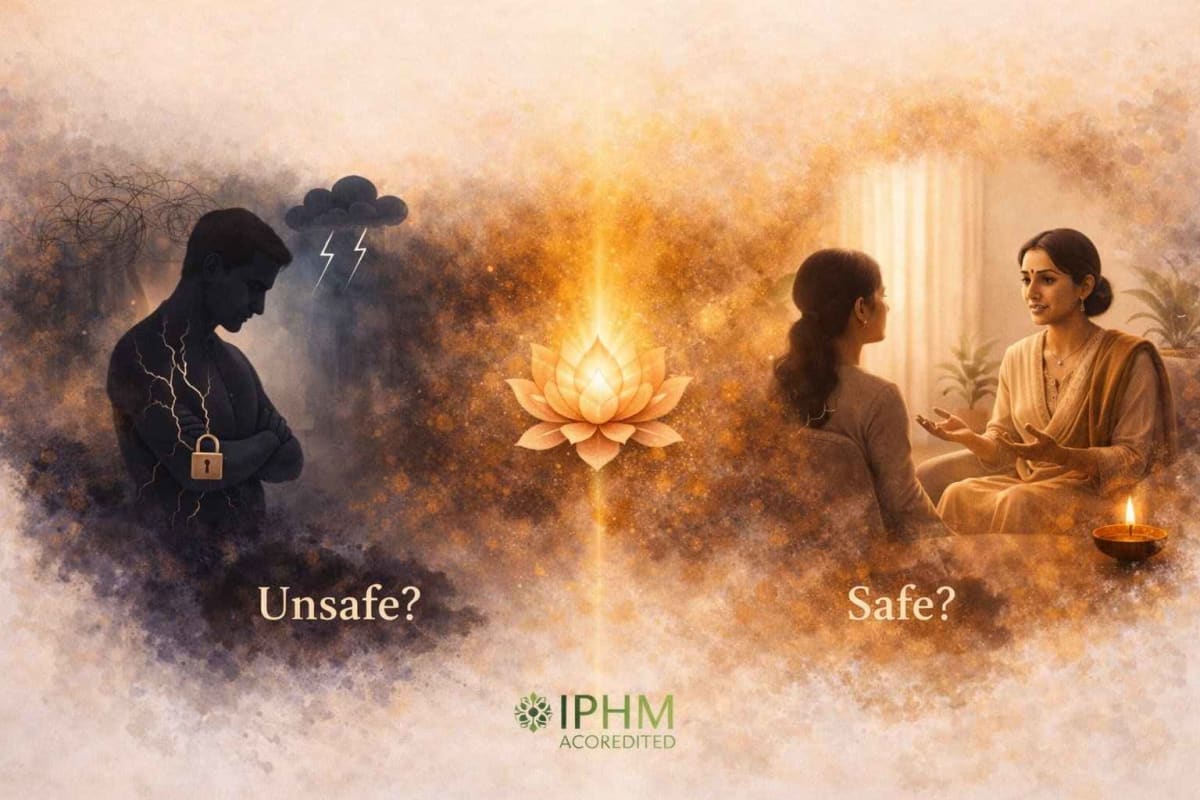
What Makes Shadow Work Safe — And What Does Not
Shadow work has gained significant cultural momentum in India and internationally.
And with that momentum has come a substantial amount of poorly facilitated, poorly understood practice.
A shadow work journal.
A social media prompt.
A weekend retreat run by someone with three months of training.
These are not inherently harmful, but they are also not equipped to handle what can arise when the shadow genuinely begins to move.
Genuine shadow work involves contact with material that has been protected for a reason.
Trauma lives in the shadow.
Shame lives in the shadow.
Grief that was never allowed lives in the shadow.
When these begin to surface without appropriate containment, the result can be destabilisation rather than integration.
The person is opened without being held.
Safe shadow work requires three things:
- A trained, credentialed facilitator who understands trauma, the nervous system, and the architecture of unconscious protection
- A structured methodology that paces the work appropriately and does not overwhelm the system
- A somatic foundation, because the shadow is held in the body and the work needs to meet it there
This is not optional.
It is also why credentials matter in this field more than in almost any other area of personal development.
Not as performance, but as a genuine indicator of what the practitioner is actually equipped to hold.
My Approach: Shadow Mapping™ (SM™)
I am India's Only IPHM Accredited Shadow Work Expert, and the methodology I have developed over 22 years of transformational practice is called Shadow Mapping™ (SM™).
It is not a journaling framework.
It is not a group catharsis process.
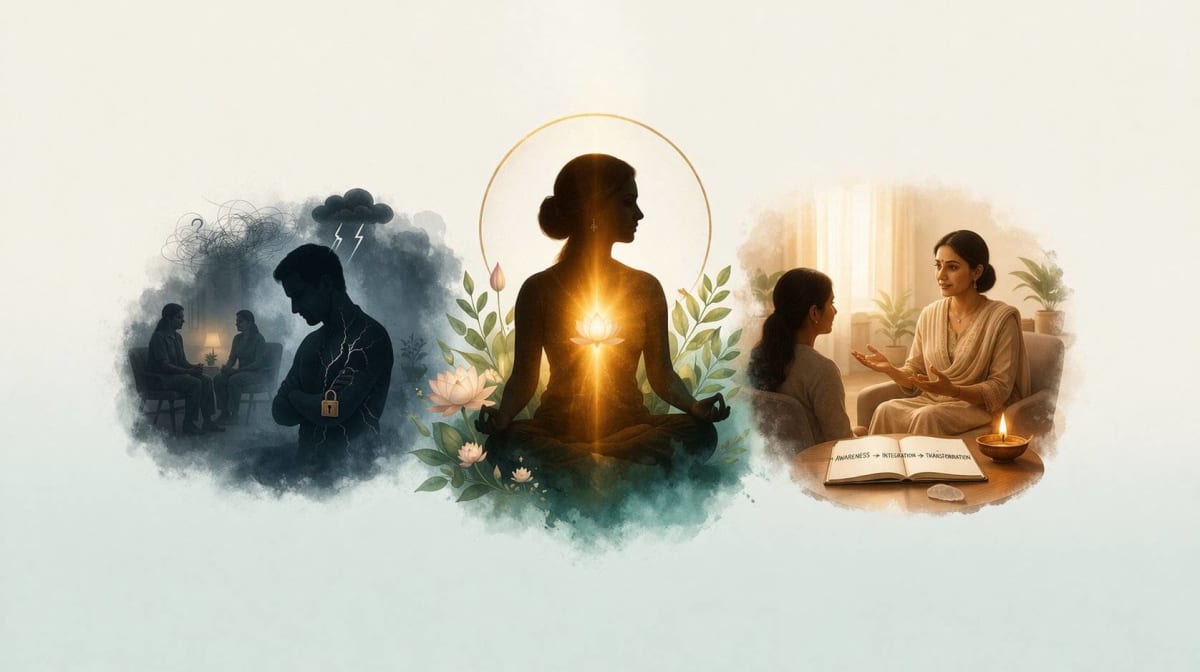
It is a precise, structured, somatic methodology built on four movements.
- Identifying the specific shadow pattern that is most active in your life right now — not generically, but with clinical precision
- Tracing its origin — where it was formed, what it was protecting you from, and what purpose it has been serving
- Working somatically — meeting the shadow in the body where it is held, through NeuroSomatic Breathwork™ (NSB™) and nervous system regulation practices
- Integration — not eliminating the shadow part, but restoring its capacity to function as a resource rather than a compulsion
The results of this process are structural.
They do not wear off the way insight wears off, or the way a motivational high wears off.
The pattern is met at the level where it actually lives, and that changes something that does not revert.
Who This Work Is For
The people I work with are typically high-functioning adults who are capable and accomplished externally but internally exhausted, vigilant, or quietly stuck in ways they cannot fully explain.
- Coaches, therapists, healers, and facilitators who want to go deeper in their own inner work
- Leaders and founders who have done significant personal development and sense there is a layer beneath it that has not moved
- Anyone experiencing a recurring pattern in relationships, money, health, or creativity that nothing else has been able to shift
- People in chronic nervous system dysregulation, anxiety, burnout, hypervigilance, or dissociation who are ready to work at the root rather than manage symptoms indefinitely
You cannot take a client further than you have gone yourself.
Your First Step
If you have read this far, something in this article has already been recognised.
You do not need to know exactly what to call it yet.
The free Shadow Work Start Kit is the right starting point.
It covers what shadow work is, why you need it, how it manifests in your life, and how integration actually works.
It is the most grounded, expert-led introduction to this work available in India today.
Download the free Shadow Work Start Kit
When you are ready to go deeper, the 3 Hour Shadow Work Masterclass (Live) is where the actual work begins.
With full safety, expert facilitation, and a somatic foundation that makes the process genuinely integrative rather than just emotionally stimulating.
Book your place in the 3 Hour Shadow Work Masterclass
One Last Thing
The shadow does not diminish with time.
It becomes more organised, more sophisticated, more invisible.
But not smaller.
Every year you do not look at it, it becomes more fluent in your language, more skilled at generating the situations that keep it in place, more convincing in its argument that the problem is external rather than internal.
Shadow work is not a trend.
It is the most direct path available to the kind of inner change that actually holds — in your relationships, your work, your health, and your experience of being alive.
The question is not whether you have a shadow.
You do. We all do.
The question is whether you are ready to stop letting it run the show.

Written by
Aditi Nirvaan
India's Only IPHM Accredited Shadow Work Expert, TEDx Speaker, and creator of Shadow Mapping™, NeuroSomatic Breathwork™ & Destiny Map™. Featured in Vogue India, Times of India, Mid-Day & Life Positive.