Is Shadow Work Safe? What You Need to Know Before You Start
“India's Only IPHM Accredited Shadow Work Expert, Aditi Nirvaan, gives the most honest answer to the most important question in shadow work. Is it actually safe, and what makes the difference.”
Is Shadow Work Safe? What Most People Get Wrong About Healing, Trauma, and the Nervous System
This is the question I get asked most often.
And it deserves an honest answer.
Not a reassuring one.
Not a marketing one.
Because the truth is this:
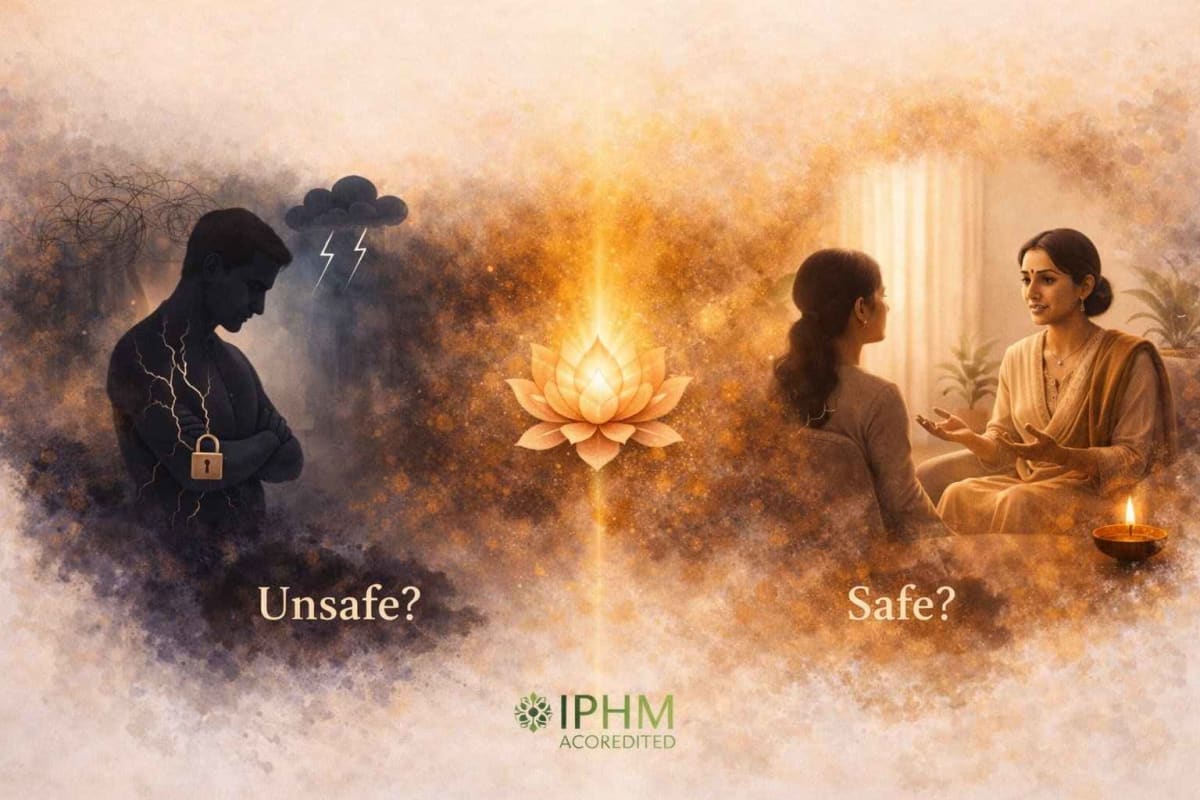
Shadow work is not automatically safe.
It is also not automatically dangerous.
And the difference between those two outcomes depends almost entirely on one thing:
The quality of the container in which the work happens.
If you are asking this question before beginning, that instinct is healthy.
Most people who become destabilised by shadow work never asked it.
They saw:
- A social media reel
- A journaling prompt
- A trending “healing” conversation
And began digging into territory they were not equipped to navigate alone.
So let me give you the complete picture:
- What makes shadow work safe
- What makes it risky
- Who needs extra care
- And what the non-negotiables are before you begin
Why This Question Matters More Than Ever
Shadow work has gone mainstream in a way Carl Jung could never have predicted.
Vogue India has featured shadow journaling.
Elle India has covered shadow work as the next major self-development trend.
And while this visibility has opened important conversations, it has also created a serious safety issue.
Because much of what circulates online under the label of shadow work is disconnected from the psychological and somatic rigour required for this work to be genuinely safe.
Shadow work is not inherently dangerous in the way uncontained psychedelic work or poorly facilitated breathwork can become dangerous.
But it is also not merely journaling.
When approached without:
- Structure
- Pacing
- Nervous system awareness
- Skilled facilitation
It can open material the person is not yet equipped to process.
What Can Actually Go Wrong
Let us move beyond vague warnings and speak precisely.
Emotional Flooding Without Containment
The shadow contains material pushed underground for a reason.
At the time it formed, the nervous system could not fully process it.
When this material surfaces without enough regulation capacity or proper guidance, the nervous system can become overwhelmed rather than integrated.
The person enters acute activation without a map for how to move through it safely.
Re-Traumatisation Instead of Integration
There is a profound difference between:
- Revisiting trauma
- Integrating trauma
Replaying painful memories or emotionally reliving difficult experiences without proper somatic processing can reinforce the original trauma rather than heal it.
This is one of the most common risks of unguided shadow work.
Destabilising Protective Structures Too Quickly
The shadow is not only a repository of wounds.
It is also a system of protection.
Many unconscious patterns exist because they once helped the person survive.
Keeping:
- The nervous system functional
- Relationships intact
- The psyche within tolerable limits
Shadow work that moves too quickly can dismantle those protective structures before the person has developed the internal resources needed to replace them.
Using Shadow Work as Self-Punishment
Spiritual bypassing is widely discussed.
Its reverse is discussed far less.
Using shadow work as a way to:
- Dwell in pain endlessly
- Turn suffering into identity
- Attack oneself psychologically
This is not integration.
It is another form of unconscious protection.
Misidentifying the Actual Pattern
Without proper guidance, people frequently mistake:
- The protector for the shadow itself
- The emotion for the deeper pattern
- The story for the somatic imprint beneath it
The result is years of sincere effort that never fully reaches the root of the issue.
The Myths vs. The Reality
Myth: Shadow Work Will Pull You Into Darkness
Actually, the opposite is true.
The shadow causes suffering precisely because it operates unconsciously.
Integration reduces the darkness by bringing unconscious material into conscious relationship.
Myth: You Must Relive Trauma to Heal It
Trauma-informed shadow work does not require re-experiencing traumatic events.
It works with:
- The nervous system pattern
- The somatic imprint
- The protective strategy created by the trauma
Not the repeated retelling of the story.
Myth: Shadow Work Journaling Is Full Shadow Work
Journaling can support self-awareness.
But journaling alone is not deep shadow work.
Real shadow work involves:
- The unconscious
- The nervous system
- Somatic integration
- Protective structures operating beneath awareness
Confusing journaling with full shadow work is like confusing first aid with surgery.
Myth: If It Feels Intense, It Must Be Healing
Intensity is not proof of transformation.
Some of the deepest integrations happen quietly.
With:
- Precision
- Clarity
- Steady nervous system regulation
Extreme catharsis without integration often creates activation, not healing.
Who Needs Extra Care Before Beginning
Shadow work is appropriate for most psychologically stable adults genuinely committed to inner work.
But there are situations requiring additional care.
If You Are Currently in Acute Crisis
If you are experiencing:
- Active suicidal ideation
- Recent severe trauma
- Acute psychosis
- Severe dissociation
Stabilisation comes first.
Shadow work is a depth practice.
Depth practices require a baseline of nervous system safety.
If You Have Complex Trauma or CPTSD
Shadow work can still be deeply beneficial.
But only with a facilitator trained in:
- Trauma-informed approaches
- Somatic work
- Nervous system regulation
- Pacing within your window of tolerance
Not all facilitators have this training.
This matters enormously.
If You Are New to Inner Work Entirely
Shadow work is not the ideal starting point for completely solo exploration.
The first step is building nervous system regulation capacity.
The physiological ability to remain present with difficult material without becoming overwhelmed.
This can be developed relatively quickly.
But it cannot be skipped.
The Three Non-Negotiables for Safe Shadow Work
1. Nervous System Regulation Comes First
Safety in shadow work is physiological before it is psychological.
The nervous system needs enough regulated capacity to meet difficult material without entering:
- Fight
- Flight
- Freeze
- Collapse
Without regulation, shadow work often becomes activation rather than integration.
This is why somatic practices and nervous system work are foundational.
Not optional extras.
2. The Methodology Must Be Structured and Properly Paced
Safe shadow work does not open everything at once.
It works incrementally.
Building integration capacity gradually.
Any methodology that prioritises:
- Drama
- Catharsis
- Emotional intensity
Over pacing and integration is far more likely to destabilise than heal.
3. The Facilitator Must Be Trauma-Informed and Properly Trained
This is the single most important variable.
A skilled facilitator provides far more than emotional support.
They bring:
- Clinical precision
- Somatic awareness
- Nervous system tracking
- Trauma-informed pacing
- Integration skills
The unconscious cannot fully see itself alone.
That is the nature of the shadow.
This is why credentials matter.
Not performatively.
Practically.
Questions to Ask Any Shadow Work Facilitator
Before working with anyone, ask:
- What is your specific training in shadow work?
- Who trained you?
- Are you trauma-informed?
- How do you work with the nervous system?
- What somatic methods do you use?
- How do you close and integrate sessions safely?
- What are your professional boundaries and scope?
- Do you receive ongoing supervision or consultation?
- Have you done your own deep shadow work?
A skilled facilitator answers these questions with:
- Specificity
- Humility
- Depth
Not vague promises about transformation.
A Particular Concern in India
The shadow work space in India is growing rapidly.
Faster than the structures training practitioners safely.
Weekend certifications and social media visibility are increasingly being mistaken for actual competence.
This is not criticism of individuals.
It is a structural issue within a rapidly expanding industry.
And Indian clients often carry extraordinarily deep material:
- Complex family systems
- Multigenerational conditioning
- Performance pressure
- Cultural identity conflict
- Suppressed emotional histories
This material deserves genuine depth and skill.
Not performative healing culture.
So, Is Shadow Work Safe?
Yes.
Absolutely — when the right conditions exist.
When shadow work is:
- Trauma-informed
- Somatically grounded
- Nervous-system aware
- Properly paced
- Held by a trained facilitator
It becomes one of the most profound forms of inner transformation available.
The Shadow Mapping™ (SM™) methodology integrated with NeuroSomatic Breathwork™ (NSB™) was built specifically around these principles.
Every process is:
- Trauma-informed
- Structured
- Nervous-system based
- Designed for integration rather than activation
This is what safe shadow work actually looks like.
Not random catharsis.
Not endless emotional excavation.
A precise, expertly held process meeting the shadow where it actually lives:
- In the body
- In the nervous system
- In unconscious protective patterns
Before You Begin
Ask yourself honestly:
- Am I psychologically stable right now?
- Do I have basic nervous system regulation tools?
- Have I properly vetted the facilitator?
- Do I have support outside sessions?
- Am I approaching this work from readiness rather than urgency?
- Do I understand the difference between productive discomfort and destabilisation?
If the answer is yes, you are likely ready to begin.
The Safest Place to Begin
The 3 Hour Shadow Work Masterclass (Live) is the safest and most rigorously structured entry point into genuine shadow work available in India today.
It is:
- Trauma-informed
- Somatically grounded
- Clinically structured
- Built on a proprietary methodology refined across 22 years
Not a trend.
Not a weekend certification framework.
A deeply held, precise process developed through direct work with more than 50,000 people across India and internationally.
Book your place in the Shadow Work Masterclass
And if you want to understand the deeper karmic patterns beneath your shadow — the unconscious imprints shaping your life beneath awareness — the Destiny Map™ session is where that layer of the work begins.
Written by
Aditi Nirvaan
India's Only IPHM Accredited Shadow Work Expert, TEDx Speaker, and creator of Shadow Mapping™, NeuroSomatic Breathwork™ & Destiny Map™. Featured in Vogue India, Times of India, Mid-Day & Life Positive.