Shadow Work vs. Inner Child Work: What's the Difference?
“Aditi Nirvaan, India's Only IPHM Accredited Shadow Work Expert, explains the precise difference between shadow work and inner child work, how they overlap, and which one you actually need right now.”
Shadow Work vs Inner Child Work: What Is the Difference — And Which One Do You Actually Need?
If you have spent any time in personal development, therapy, or healing spaces, you have almost certainly encountered both of these terms.
And if you are honest, you may also have quietly wondered:
“Are these actually different things, or just different branding for the same process?”
They are not the same thing.
They overlap in important ways.
But they work at different levels of the psyche, target different material, and produce different kinds of transformation.
Understanding the difference matters practically, not just conceptually.
Because choosing the wrong entry point can mean spending years doing genuine, sincere work that never quite reaches the thing that actually needs to shift.
Where Both Practices Come From
Both shadow work and inner child work emerge from the broader tradition of depth psychology:
The study of unconscious dimensions of human experience that shape behaviour, emotion, relationships, and identity beneath conscious awareness.
Shadow Work
Shadow work originates with Carl Gustav Jung, the Swiss psychiatrist who described the shadow as the unconscious repository of everything the ego cannot fully accept about itself.
Not only the “dark” qualities.
Also the positive ones:
- Power
- Ambition
- Sensuality
- Brilliance
- Need
- Vulnerability
Anything that once felt unsafe, unacceptable, or incompatible with belonging.
Inner Child Work
Inner child work draws from several traditions:
- John Bradshaw’s work on the wounded inner child
- Attachment theory
- Object relations theory
- Internal Family Systems (IFS)
It focuses specifically on the younger developmental parts of the self that experienced:
- Wounding
- Neglect
- Abandonment
- Emotional deprivation
- Trauma
And that continue influencing adult life from beneath awareness.
What both approaches share is one core recognition:
The past is not past.
It is still operating in the present through:
- Patterns
- Relationships
- Nervous system responses
- Emotional reactions
Until it is consciously met and integrated.
What Inner Child Work Actually Is
Inner child work reconnects you with younger versions of yourself that experienced wounds, unmet needs, or overwhelming emotional experiences.
The inner child is not merely symbolic.
It is a living psychological reality:
- Emotional memories
- Protective strategies
- Frozen developmental states
- Unmet longings
Still operating with the emotional logic of the child who originally experienced them.
Inner child work often involves:
- Identifying the age or developmental stage where the wound formed
- Meeting that younger self compassionately
- Releasing stored grief, fear, shame, or rage
- Restoring qualities that were shut down:
- Playfulness
- Trust
- Curiosity
- Spontaneity
The primary orientation of inner child work is:
Nurturing and reparenting.
It is fundamentally an act of love toward wounded parts of the self.
What Shadow Work Actually Is
Shadow work is the process of identifying, acknowledging, and integrating the parts of yourself pushed into the unconscious.
Not necessarily because they were wounded.
But because they were:
- Unsafe to express
- Socially unacceptable
- Too powerful
- Too vulnerable
- Too threatening to belonging
The shadow contains:
- The rage you suppressed
- The ambition you learned to hide
- The sensuality you were shamed for
- The needs you decided were “too much”
- The power you learned would make people uncomfortable
Shadow work involves:
- Recognising projections
- Identifying recurring unconscious patterns
- Tracing where parts were split off
- Restoring disowned material to conscious relationship
The goal is not elimination.
It is integration.
The primary orientation of shadow work is:
Wholeness.
Not becoming “better.”
Becoming more fully yourself.
The Core Difference: Wound vs Disownment
This is the cleanest distinction I know.
Inner Child Work Addresses the Wound
The emotional injury.
The unmet developmental need.
The younger part still carrying pain from what happened.
Shadow Work Addresses the Disownment
The parts of self split off from conscious identity.
The qualities pushed underground and now operating unconsciously.
A wound can absolutely create a shadow.
The child shamed for anger develops:
- A wound of shame
- A shadow of suppressed rage
But shadow material also includes qualities that were not obviously wounded.
Only disowned.
Inner child work heals.
Shadow work integrates.
Both are necessary.
How They Overlap
In practice, these processes are deeply intertwined.
Most shadow material originates during childhood.
Which means most shadow patterns have an inner child wound somewhere beneath them.
The child praised only for achievement develops:
- A wound of conditional love
- A shadow around worthiness, rest, and authenticity
The child who learned invisibility develops:
- A wound of emotional neglect
- A shadow around self-expression and visibility
This means:
- Deep shadow work eventually encounters inner child material
- Deep inner child work eventually encounters shadow patterns
The more useful question is not:
“Which one is better?”
It is:
“Which is the right entry point for what I am carrying right now?”
Which One Do You Actually Need?
Inner Child Work May Be the Better Starting Point If:
- You carry clear childhood wounds:
- Abandonment
- Neglect
- Parentification
- Criticism
- Emotional deprivation
- Your emotional reactions feel visibly connected to younger parts of yourself
- You struggle with:
- Self-soothing
- Self-compassion
- Feeling emotionally safe
- Your primary experience is pain, emptiness, or emotional longing
Shadow Work May Be the Better Starting Point If:
- You experience recurring patterns that continue despite significant self-awareness
- You are intensely triggered by specific qualities in other people
- There are parts of yourself you cannot access cleanly:
- Anger
- Power
- Sensuality
- Need
- Softness
- You have done years of healing work but still sense something deeper remains untouched
- Your experience feels less like pain and more like being unconsciously driven by something unnamed
You Probably Need Both If:
- You are outwardly high-functioning but internally exhausted
- You have done extensive personal development without structural change
- You are a coach, therapist, healer, or facilitator wanting to go deeper yourself before guiding others deeper
The Indian Context
In India, this distinction has a specific cultural texture.
Many adults raised in:
- Joint family systems
- High-expectation environments
- Emotionally restrictive households
Carry both:
- Significant inner child wounds
- Large shadow structures
The child raised to become the family’s pride often carries:
- A wound of conditional love
- A shadow around rest, pleasure, authenticity, and emotional need
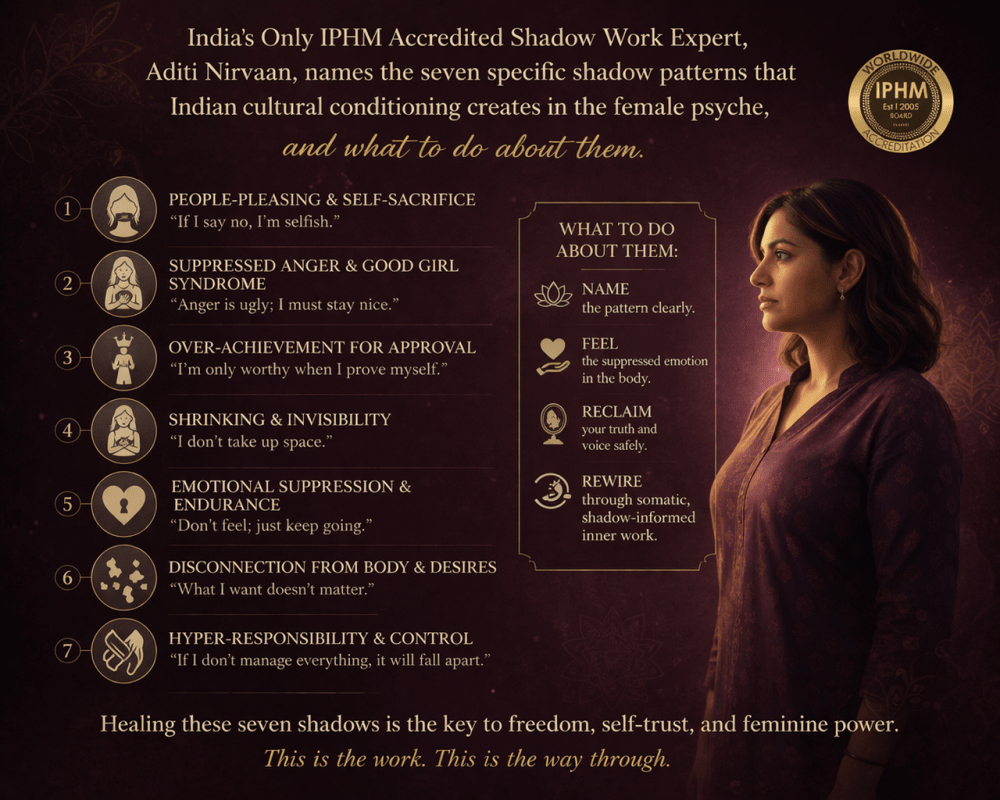
The woman praised for sacrifice may carry:
- A wound of invisibility
- A shadow around anger, ambition, and authority
The man taught emotional suppression may carry:
- A wound of emotional isolation
- A shadow around softness, tenderness, and vulnerability
These are not separate problems.
They are two dimensions of the same underlying split.
How My Work Integrates Both
The methodologies I developed over 22 years:
- Shadow Mapping™ (SM™)
- NeuroSomatic Breathwork™ (NSB™)
- Destiny Map™ (DM™)
Do not force you to choose between shadow work and inner child work.
They work at the level where both actually live:
The nervous system.
Both shadow patterns and inner child wounds are stored somatically.
In:
- The body
- The breath
- The nervous system
- Habitual physiological responses
The throat tightens.
The chest contracts.
The jaw braces.
These are not abstract psychological ideas.
They are embodied realities.
NeuroSomatic Breathwork™ works directly with this somatic layer.
Shadow Mapping™ identifies precisely what pattern is operating.
Destiny Map™ reveals the larger karmic structure beneath the pattern.
This is why the work produces structural change rather than temporary emotional relief.
A Note on Sequencing
If you are new to this work, start with safety.
Before either shadow work or inner child work can go deeply, the nervous system needs enough regulation capacity to meet the material safely.
This does not take years.
But it matters.
And once the system has enough stability, the process itself will reveal whether the material is primarily:
- A wound
- A disowned part
- Or both simultaneously
You do not need to diagnose yourself in advance.
You need the right container and the right guide.
Where This Work Begins
If you are ready to stop choosing between modalities and begin working at the level where both shadow and inner child material actually live:
- In the body
- In the nervous system
- In the unconscious patterns shaping your life
The 3 Hour Shadow Work Masterclass (Live) is the right starting point.
It is:
- Trauma-informed
- Somatically grounded
- Expert-facilitated
- Structured for real integration rather than emotional catharsis
Book your place in the 3 Hour Shadow Work Masterclass
And if you want to understand the deeper karmic patterns beneath both your wounds and your shadow, the Destiny Map™ session is where that layer of the work begins.

Written by
Aditi Nirvaan
India's Only IPHM Accredited Shadow Work Expert, TEDx Speaker, and creator of Shadow Mapping™, NeuroSomatic Breathwork™ & Destiny Map™. Featured in Vogue India, Times of India, Mid-Day & Life Positive.