Shadow Work for Indian Women: The Patterns Nobody Talks About
Shadow Work & Emotional Patterns

Shadow Work for Indian Women: The Patterns Nobody Talks About

Aditi Nirvaan
December 15, 2025
13 views
16 min read

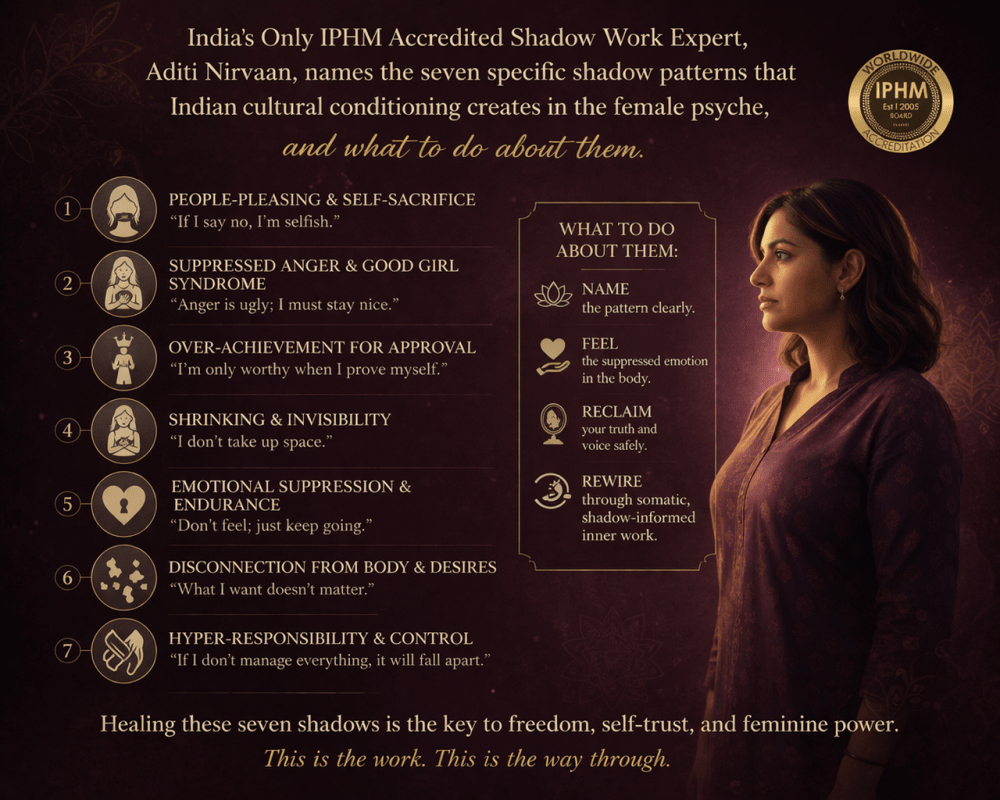
India's Only IPHM Accredited Shadow Work Expert, Aditi Nirvaan, names the seven specific shadow patterns that Indian cultural conditioning creates in the female psyche, and what to do about them.

Tags:
shadow work Indian women

There is a particular kind of exhaustion that Indian women carry.

It is not the tiredness of doing too much, though that is real too. It is something quieter than that. The exhaustion of being two people at once. The woman who handles everything, holds everyone, appears capable and composed and grateful and good. And the woman underneath, who has been waiting, sometimes for decades, to be asked how she actually is.

This article is for the second woman.

Not to celebrate her suffering, and not to frame her as a victim. But to name, as precisely and honestly as I can, the specific patterns that Indian cultural conditioning creates in the female psyche. Patterns that are so thoroughly woven into the fabric of daily life that most Indian women have never had the language to identify them, let alone a container in which to begin working with them.

Shadow work, for Indian women, is not a Western import. It is a homecoming.


Why Indian Women Carry a Particular Shadow

The shadow, in Jungian psychology, is everything we have pushed out of conscious awareness because it felt too dangerous, too shameful, or too incompatible with who we believed we needed to be in order to survive, belong, or be loved.

For Indian women, the architecture of that disownment is specific. It is built from multigenerational conditioning, patterns that were not just taught but absorbed through watching mothers and grandmothers navigate identical constraints with the same quiet endurance. It is built from a culture that praises self-erasure, where the woman who sacrifices most is the most respected and the woman who asks for most is the most problematic. It is built from the equation of emotional suppression with virtue, where silence is strength and need is burden. And it is built from invisible labour that is structurally unrecognised. Indian women spend over five hours per day on unpaid domestic and emotional work, three times more than men, with almost no cultural acknowledgement of what that costs psychologically over a lifetime.

This is not a political argument. It is a psychological one. These structural realities create specific, predictable shadow patterns in the Indian female psyche. Patterns that persist even when the external conditions improve, even when the woman is professionally successful and financially independent and living a life that looks, by every external measure, like it should feel like enough.

The shadow does not update itself when the circumstances change. That is not how it works. It requires deliberate, structured, expert-guided work to integrate.


The Patterns

These are the seven shadow patterns I encounter most consistently in my work with Indian women. They are not universal. Every woman's shadow is shaped by the specific details of her own life. But they are recognisable enough that most Indian women will find themselves in at least four of them.

Read slowly. Notice what lands in the body, not just the mind.


Pattern 1: The Shadow of Anger

This is the most suppressed emotion in the Indian female psyche, and therefore the one with the largest shadow.

Indian girls learn very early that their anger is unacceptable. It is unladylike. It frightens people or hurts them or makes them leave. The good Indian woman does not raise her voice. She manages. She adjusts. She finds a way.

The anger does not disappear. It goes underground, where it surfaces as chronic physical tension in the jaw, the shoulders, the lower abdomen, held so consistently it has been mistaken for personality. It appears as the withheld warmth, the carefully calibrated withdrawal, the remark that lands slightly harder than intended. It turns inward and becomes depression, which is frequently anger directed at the self rather than the situation that warranted it. And periodically it breaks through in explosions that feel disproportionate, followed by shame, which drives the anger further underground, which creates more pressure, which creates more explosions.

A study published in the Indian Journal of Social Psychiatry found that nearly half of Indian women experience chronic stress, 47% struggle with insomnia, and 41% report social isolation. These are clinical indicators entirely consistent with the long-term somatic effects of sustained emotional self-silencing.

The shadow work here is not, at first, about learning to express anger appropriately. That may come later. It is about meeting the anger that was never allowed to exist, restoring it to consciousness, and recognising it as what it actually is. The energy of boundary, of self-respect, of genuine desire.


Pattern 2: The Shadow of Ambition

Indian women in professional environments across Mumbai, Delhi, and Bengaluru are outperforming their male peers by measurable metrics, and simultaneously carrying a profound, often unconscious conflict about what their success means and whether they are actually permitted to want it.

The shadow of ambition is the disowned desire to be seen, recognised, powerful, and at the centre of the room, in a culture that has historically praised women for supporting others' dreams rather than pursuing their own.

It shows up as the glass ceiling with no external explanation, where the strategy is in place and the skills are present and the network is strong, but something invisible keeps pulling back at the threshold of the next level. It shows up as imposter syndrome so pervasive it has become a baseline rather than a reaction to new situations. It shows up as the compulsive diminishment of achievement, the reflexive "oh it was nothing really" performed before anyone has even had a chance to be threatened by the success. And it shows up as guilt about the career opportunity taken in another city, the business travel that pulled away from the family, the choice to put professional growth first, each carrying a residue of cultural shame that rational argument does not dissolve.

The shadow here holds the woman's full, unapologetic ambition. Not the ambition that performs confidence while internally bracing for punishment, but the ambition that rests in genuine self-trust.


Pattern 3: The Shadow of Need

This is perhaps the most invisible shadow pattern for Indian women, because it wears the costume of virtue so convincingly.

The Indian woman who does not need much, who does not complain, who gives endlessly and asks for nothing, is praised. She is the ideal. She is what a good woman looks like.

The needs do not disappear. They go into the shadow, where they operate as chronic resentment that cannot be named, because naming it would require acknowledging the need that was not met, which would require acknowledging that the need existed, which feels like ingratitude or selfishness. They operate as an inability to receive, where compliments are deflected, help is refused, rest is guilt-ridden, and love is held at a slight distance where it feels safer than letting it fully land. They operate as over-giving, pouring into others what was never given to the self, with an unconscious hope that the loop will eventually close.

Research on self-silencing theory shows a direct clinical link between the suppression of genuine needs in relationships and depression in Indian women. The more women silence themselves to maintain peace, the higher the psychological cost over time.

The shadow work here is one of the most tender and most difficult in the Indian female experience. Meeting the need itself. Not strategising about how to get it met. Not reframing it into something more palatable. Meeting it with the same quality of seriousness that the Indian woman has been giving to everyone else's needs for her entire life.


Pattern 4: The Shadow of the Body

The Indian female body has been a site of cultural regulation for as long as anyone can trace. What it wears, how it moves, who it belongs to, what it is permitted to desire, what it is required to produce.

The shadow of the body is the disowned relationship with one's own physical experience, including pleasure, desire, hunger, rest, and the simple right to occupy space without apology or justification.

It shows up as chronic disconnection from physical sensation, living in the head, managing from the neck up, treating the body as a vehicle for productivity rather than a home to be inhabited. It shows up as shame about physical needs, where hunger and rest and sexual desire and physical illness each carry a residue of being too much or not managing properly. It shows up in the persistent experience of the body as something to be controlled rather than listened to. And it shows up as unexplained somatic symptoms, the chronic back pain, the persistent gut issues, the recurring headaches, the insomnia, that medicine treats at the surface but that have their roots in the body's faithful, unheard communication of what the psyche cannot yet process in any other way.

Shadow work that is genuinely somatic, that works directly with the body through breathwork and nervous system regulation, is the only approach I have found that can reach this layer of the shadow.


Pattern 5: The Shadow of the Good Daughter, the Good Wife, the Good Mother

This is the most structurally ingrained shadow pattern in the Indian female psyche, and the one that is hardest to name without immediately feeling disloyal or ungrateful or selfish.

The good woman persona, the constellation of behaviours and tones and expressions and self-presentations that Indian women learn to perform in order to be loved and safe and socially acceptable, is not the woman herself. It is an adaptation. A highly functional, highly praised, deeply exhausting adaptation that has, in many cases, been running so long it has been mistaken for identity.

The shadow here is everything the good woman persona cannot contain. The parts of the self that are complicated, contradictory, inconvenient, demanding, unconventional, or simply too much for the role to accommodate.

It shows up as a persistent sense of performing one's own life, going through the right motions, saying the right things, inhabiting the expected role, while something underneath watches with a quiet steady awareness that this is not the whole story. It shows up as a genuine inability to know what she actually wants, because wanting has been subordinated to what is expected for so long that desire has become genuinely inaccessible. It shows up in the woman in her late 30s or 40s who has done everything correctly and finds herself standing in the middle of a life that looks right and feels hollow. And it shows up as rage at being unseen. Not at any particular person. At the structural reality that the most essential parts of her have never had a container safe enough to be visible, even to herself.

The Vedic tradition understood this. Draupadi's rage, her humiliation in the dice hall, her vow of unbound hair, her demand for justice, is not the shadow of a broken woman. It is the shadow of a woman who was required to be good in a system that was not. Her anger was not pathological. It was the truth of her situation, finally refusing to be silent.


Pattern 6: The Shadow of Multigenerational Transmission

The Indian woman's shadow is not only her own.

It carries the unprocessed material of the women who came before her. Her mother, her grandmother, her great-grandmother. Women who had fewer resources, less permission, smaller containers for their inner lives. Women who survived by suppressing, and who passed that suppression on not through deliberate instruction but through the lived transmission of how to be a woman in this family, in this culture, under these conditions.

This is not metaphor. Epigenetic research has documented the ways in which stress responses, emotional patterns, and survival adaptations are passed from one generation to the next through both environmental modelling and biological transmission. The Indian woman who finds herself repeating her mother's patterns, despite having vowed not to, despite genuine insight, despite significant personal work, is not failing. She is carrying material that was never hers alone to resolve.

It shows up as patterns that feel ancient rather than personal, carrying a quality of weight or inevitability that does not match the current circumstances. It shows up in the mother wound, the complex often unspoken dynamic in which the mother's unmet needs and suppressed shadow are transmitted to the daughter as expectation or criticism or emotional enmeshment. It shows up as the grandmother's silence, the sense that something significant happened in the generation before that was never spoken about, that shaped everything and was never integrated. And sometimes it shows up as a loyalty to suffering, an unconscious sense that if she heals, she is somehow betraying the women who did not have the chance to.

Shadow work that is sensitive to multigenerational patterns works not just with the individual woman's material but with the lineage, acknowledging what was carried, making it conscious, and making it possible to choose, with full awareness, what to continue and what to lay down.


Pattern 7: The Shadow of Spiritual Bypassing

This pattern belongs to a particular subset of Indian women, those who are drawn to yoga, meditation, spirituality, and healing. And it is the one most likely to go unnoticed, because it wears the costume of awakening so convincingly.

Spiritual bypassing is the use of spiritual practice to avoid emotional reality. To float above the pain rather than move through it. To achieve a quality of serenity that is not the product of genuine integration but of careful avoidance dressed as equanimity.

For spiritually inclined Indian women, this pattern is particularly seductive because the culture already valorises the transcendence of emotion as a spiritual ideal. The woman who has risen above her anger, her need, her desire, who is serene and unattached and compassionate, is celebrated. Never mind that beneath the serenity, the anger is still there. The need is still there. The desire is still there. Just better managed, better hidden, given a more acceptable name.

It shows up as a spiritual practice that feels profound in the short term but has not shifted the deep patterns, years of meditation and yoga and retreats with the same relationship dynamic persisting throughout. It shows up as the inability to be genuinely angry in a spiritual context, reframing every grievance as a lesson and every wound as a gift without ever allowing the anger its legitimate, necessary place in the healing process. It shows up as a quality of spiritual performance, where the carefully curated language of gratitude and growth functions as armour against genuine vulnerability. And it shows up in the healer who has not healed, the woman who has turned her pain into a practice and her practice into a business, who helps others beautifully, and who has never allowed herself to be the one in the room who does not have it together.

The Vedic tradition, properly understood, does not bypass emotion. Shiva sits in the cremation ground with everything that has died, everything that is being burned, everything that is formless and frightening. That is not serenity achieved by avoidance. That is presence achieved by genuine, unflinching meeting.


A Note on Shame

Running beneath all seven of these patterns is a single thread.

Shame.

Shame is the emotion that keeps the shadow in place. It is the feeling that says this part of me is not just inconvenient or inappropriate. It is evidence that something is fundamentally wrong with me at my core.

For Indian women, shame operates at multiple simultaneous levels. The personal shame of individual experience. The familial shame of what the family will think. The social shame of cultural transgression. And the spiritual shame of not being evolved enough to have transcended all of this by now.

Shadow work does not eliminate shame. It illuminates it, bringing it out of its unconscious operation and into the light of conscious, compassionate examination. And in that light, shame almost always reveals itself to be exactly what it is. Not the truth about the woman, but a protection that was put in place a very long time ago by a girl who needed it.

The woman does not need it anymore. She just has not yet had the container, the safety, the expertise, the structured methodology, to find that out.


This Is Not About Being a Victim

I want to say this clearly, because it matters.

Naming these patterns is not an argument for victimhood. Indian women are among the most resourceful, resilient, and adaptive human beings on the planet. The shadow they carry is not evidence of weakness. It is evidence of what it has cost to navigate the specific conditions of being a woman in India, in a family, in a body, in a culture, across generations.

Shadow work for Indian women is not about finding someone to blame or dismantling everything that came before. It is about reclaiming the full self. The parts that were pushed underground not because they were wrong, but because the conditions did not yet exist in which they could be safely held.

Those conditions can be created. That is precisely what a well-held shadow work container does.


Where the Work Begins

I have spent 22 years working with women across India and internationally, in precisely this territory. The Shadow Mapping™ (SM™) methodology I have developed is not a generic application of Western shadow work to an Indian context. It is built from inside the Indian female experience, from the Vedic framework of samskaras, from the somatic reality of the Indian female nervous system, from the multigenerational patterns of the Indian family system, and from the specific shadow architecture that Indian cultural conditioning creates.

It is trauma-informed, somatically grounded, and held with the precision that this kind of work requires.

The 3 Hour Shadow Work Masterclass (Live) is where the work begins. It is not a retreat or a catharsis circle or a journaling workshop. It is structured, expert-held, somatic shadow work, designed for the woman who has done enough personal development to know that something deeper is waiting, and who is ready to stop managing that knowing and start actually meeting it.

Book your place in the 3 Hour Shadow Work Masterclass: (Insert Shadow Work Masterclass Landing Page link)

And if you want to understand the deeper karmic pattern beneath your shadow, the Vedic imprints that have been running your life story across multiple roles, relationships, and years, the Destiny Map™ session is where that layer of the work begins.

Book your Destiny Map session: (Insert Destiny Map Page link)


Aditi Nirvaan is India's Only IPHM Accredited Shadow Work Expert, a TEDx speaker, and the creator of Shadow Mapping™, NeuroSomatic Breathwork™, and the Destiny Map™. She has guided over 50,000 people across India and the world. Featured in Vogue India, Times of India, Mid-Day, and Life Positive. Based in Mumbai, India | aditinirvaan.com

Created: March 26, 2026Last updated: March 28, 2026

Want More Insights?

Discover more articles on personal development, mindfulness, and emotional intelligence to help you grow and thrive.

Browse All Blogs