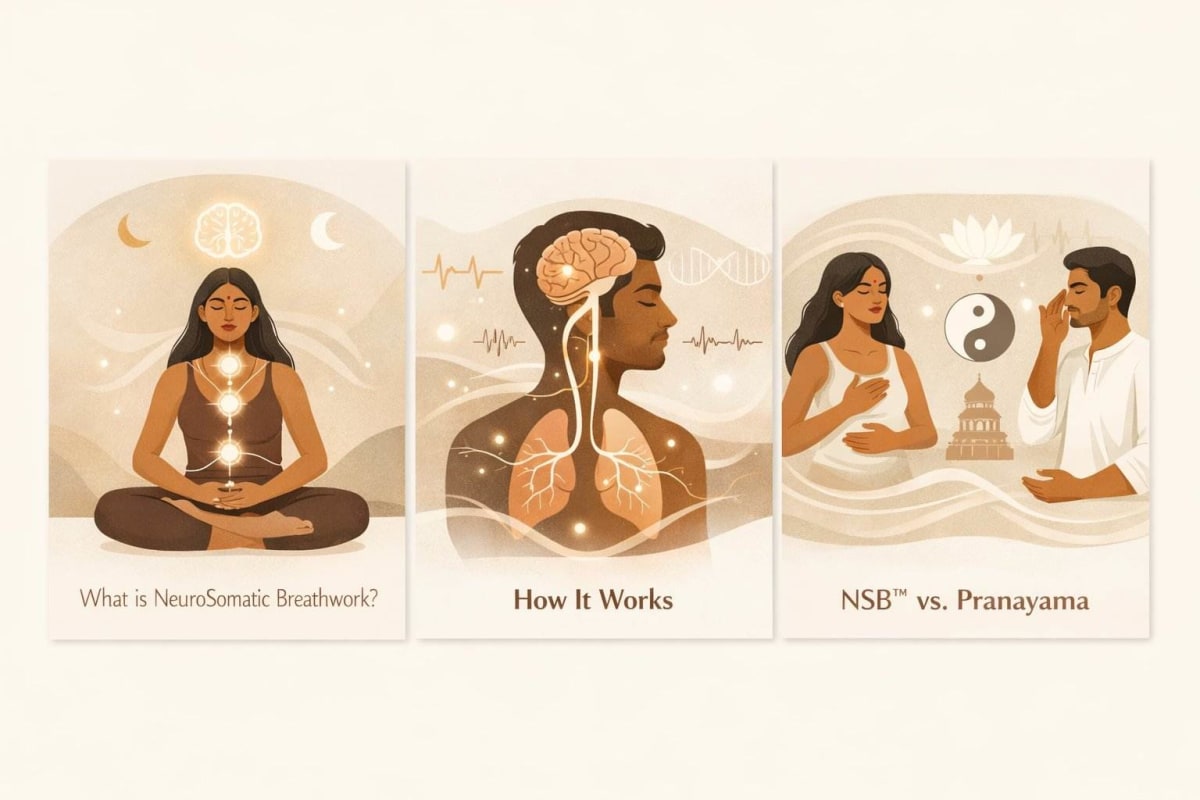
What Is NeuroSomatic Breathwork? How It Differs From Pranayama
“Aditi Nirvaan explains what NeuroSomatic Breathwork actually is, how it works mechanistically, and the precise differences between NSB™ and pranayama. Written by the creator of the methodology.”
NeuroSomatic Breathwork vs Pranayama: What Actually Makes Them Different?
Most people who find their way to my work have already spent significant time with their breath.
They have done pranayama in yoga classes. Some have done it seriously, with a dedicated teacher, for years.
They know Nadi Shodhana, Bhastrika, Kapalbhati.
They have felt the genuine effects of these practices on their nervous system, focus, and energy levels.
They are not strangers to the breath as a tool.
And then they do NeuroSomatic Breathwork™ for the first time, and they understand that these are not the same thing.
This article is an attempt to explain that difference as precisely as I can.
Not to diminish pranayama, which I have deep respect for as a practice and as a tradition.
But because the difference matters practically — for understanding what NeuroSomatic Breathwork™ actually does and why it does something that other breath practices, including pranayama, do not.
What Pranayama Actually Is
Pranayama is one of the eight limbs of Patanjali's Ashtanga Yoga, described in the Yoga Sutras as a practice of breath regulation designed to prepare the mind for meditation and ultimately for samadhi.
The word itself comes from two Sanskrit roots:
- Prana — life force or breath
- Ayama — expansion or extension
Though some translate the compound as control, the deeper meaning is closer to the expansion of the life force through conscious engagement with the breath.
Classical pranayama is a highly structured practice.
Different techniques — Nadi Shodhana, Bhastrika, Kapalabhati, Sheetali, Kumbhaka — each have specific ratios of inhalation, retention, and exhalation.
Each is said to have specific physiological and energetic effects.
Each is meant to be practised within a larger system of ethical conduct, physical posture, and progressive inner refinement.
Modern neuroscience has confirmed what the tradition has known for centuries.
Pranayama produces measurable neurophysiological effects.
Research published in the International Journal of Yoga documented the neurological mechanisms through which different pranayama techniques influence the autonomic nervous system, the limbic system, and brain wave activity.
Slow breathing practices in particular have been shown to:
- Activate the vagus nerve
- Shift the autonomic nervous system toward parasympathetic dominance
- Improve heart rate variability
- Support emotional regulation and cognitive flexibility
A 2025 EEG study found that structured breathing practices, including alternating nostril breathing and slow deep breathing, significantly modulate neuroplasticity and emotional resilience.
Pranayama works.
The science is clear on this.
And it works primarily at the level of the autonomic nervous system and the energetic body — regulating the physiological state and preparing the mind for subtler inner work.
What It Does Not Do
Pranayama is a top-down and energetic practice in its orientation.
It uses the breath as a vehicle for regulating the system, moving prana, and preparing the mind.
Its primary movement is from the practitioner's conscious intention, through the breath, into the body and nervous system.
What it does not do — and was never designed to do — is work with the specific traumatic imprints, the samskaras, that are held in the body as somatic memories.
It does not work with unconscious patterns formed through significant early experience and stored in:
- Specific locations in the body
- Specific breath constrictions
- Specific muscular holding patterns
A practitioner can do pranayama sincerely for twenty years and still carry the same somatic signature of the original wound.
Not because the practice is insufficient, but because it is not designed for that work.
The wound is not held in the general autonomic nervous system.
It is held in the specific somatic memory of a specific experience.
And reaching it requires a different kind of approach entirely.
This is not a criticism of pranayama.
It is a description of what it was designed to do — and what it was not.
What NeuroSomatic Breathwork™ Is
NeuroSomatic Breathwork™ — the NSB™ methodology I developed from over 22 years of client transformational practice — is a somatic, trauma-informed, clinically structured breathwork methodology designed to work directly with the samskaras held in the body.
The name carries the intention precisely.
- Neuro refers to the nervous system
- Somatic refers to the body — the soma
- Breathwork refers to conscious breathing used as a clinical tool for accessing and integrating material held below conscious awareness
NSB™ is not:
- A relaxation practice
- A stress management technique
- A spiritual performance experience
It is a precise, structured, clinically held process in which the breath is used to create the physiological conditions under which deeply held somatic memories can surface, be met, and begin to integrate.
The Mechanism: Why the Breath Can Do This
The breath is the only function of the autonomic nervous system that is simultaneously automatic and voluntarily controllable.
Everything else — heart rate, digestion, immune response — operates outside conscious control.
The breath operates automatically, but it can also be consciously directed.
This makes it a unique gateway.
By consciously altering the breath pattern in specific ways, it is possible to:
- Directly influence the autonomic nervous system
- Shift the physiological state
- Create conditions in which held material begins to move
Research on somatic breathwork has documented mechanisms including:
- Activation of the vagus nerve
- Changes in carbon dioxide and oxygen ratios
- Altered neurological states that support access to unconscious material
- Bypassing habitual cognitive defences through rhythmic connected breathing
But the mechanism is only part of the story.
The container in which the breathwork happens — the clinical structure, trauma-informed facilitation, and precise sequencing — is equally important.
Perhaps more so.
This is the part that most breathwork practices, including many somatic breathwork approaches, do not adequately address.
The Five Differences That Matter Most
1. Pranayama Works With Prana. NSB™ Works With Samskaras.
Pranayama is designed to regulate and expand the life force.
NSB™ is designed to identify and integrate specific unconscious karmic impressions held in the body.
Different targets. Different mechanisms. Different results.
2. Pranayama Regulates the System. NSB™ Changes the Structure of the System.
Pranayama builds regulation capacity, improves heart rate variability, and supports equilibrium.
NSB™ addresses the somatic memories generating the dysregulation in the first place.
The difference is between:
- Managing a pattern
- Changing the pattern at its root
3. Pranayama Is Practised. NSB™ Is Facilitated.
Pranayama is a personal discipline developed over time.
NSB™ is a facilitated clinical process.
It requires a trained, trauma-informed practitioner tracking the nervous system in real time throughout the session.
This is also the most important safety distinction.
NSB™ should not be practised alone or facilitated by someone without trauma-informed somatic training.
The material it can surface is significant, and the container needs to be equipped to hold it.
4. Pranayama Works Top-Down. NSB™ Works Bottom-Up.
In pranayama, conscious intention directs the breath, which then influences the body and nervous system.
NSB™ works in the opposite direction.
The breath pattern creates physiological conditions that allow held material to surface.
The body leads.
The conscious mind follows.
This bottom-up approach allows NSB™ to reach material conscious intention cannot directly access.
5. Pranayama Is a Path. NSB™ Is a Tool Within a Larger Methodology.
Pranayama exists within the larger system of yoga and spiritual practice.
NSB™ is a clinical methodology designed to work alongside:
- Shadow Mapping™ (SM™)
- Destiny Map™ (DM™)
It is not a standalone spiritual practice.
It is a somatic methodology designed for integration work.
What Actually Happens in an NSB™ Session
Without describing the proprietary structure of the methodology, this is what participants consistently report.
The session begins with:
- Assessment of the nervous system's current state
- Establishing safety and orientation in the body
- Breath patterns calibrated to the individual's capacity
The facilitator tracks the nervous system in real time throughout the session.
What surfaces varies from person to person.
Sometimes it is:
- Emotion held without expression for years
- Somatic memory
- A release of chronic contraction
- A deep sense of spaciousness
The session always ends with grounding and integration.
The goal is not activation.
The goal is metabolisation.
Participants rarely describe the outcome as merely “a powerful experience.”
They describe structural shifts:
- A compulsive pattern has more space around it
- A body that was constantly braced feels different
- Something previously automatic has changed in quality
Can Pranayama and NSB™ Work Together?
Yes.
And in my experience, they work very well together.
Pranayama builds nervous system regulation capacity.
It develops a person's ability to stay present in activating states and return to equilibrium.
This creates a genuine foundation for deeper somatic work.
A person with a strong pranayama practice often has greater capacity to stay present with what arises during NSB™ sessions.
What pranayama cannot do is clear the ground that NSB™ works with.
The somatic memories, traumatic imprints, and samskaras stored in the body require the specific trauma-informed, bottom-up methodology of NSB™.
A Note for Yoga Teachers, Pranayama Practitioners, and Somatic Professionals
If you have a serious pranayama practice, or if you teach breathwork in any form, this distinction is worth sitting with carefully.
The people who come to your classes carrying significant somatic material are not going to integrate that material through pranayama alone.
Pranayama may support regulation.
But if someone is carrying:
- Unprocessed trauma
- Significant samskaras
- Chronic nervous system dysregulation
They need work that operates at a different level.
Knowing what your tools can do — and what they cannot — is one of the most important things a practitioner can develop.
This is part of what my Certified Shadow Mastery Facilitator Programme addresses.
Not just shadow work methodology, but understanding how different modalities work at different levels and how to identify what level a person actually needs.
Where This Work Begins
The 3 Hour Shadow Work Masterclass (Live) includes an introduction to the somatic foundations that underpin NSB™, alongside the shadow work methodology that gives the breathwork its full clinical context.
It is the most direct entry point into this body of work for people who are new to it.
Book your place in the 3 Hour Shadow Work Masterclass
And if you want to understand the specific karmic pattern beneath the somatic holding you carry, the Destiny Map session is where that precise identification begins.
Written by
Aditi Nirvaan
India's Only IPHM Accredited Shadow Work Expert, TEDx Speaker, and creator of Shadow Mapping™, NeuroSomatic Breathwork™ & Destiny Map™. Featured in Vogue India, Times of India, Mid-Day & Life Positive.