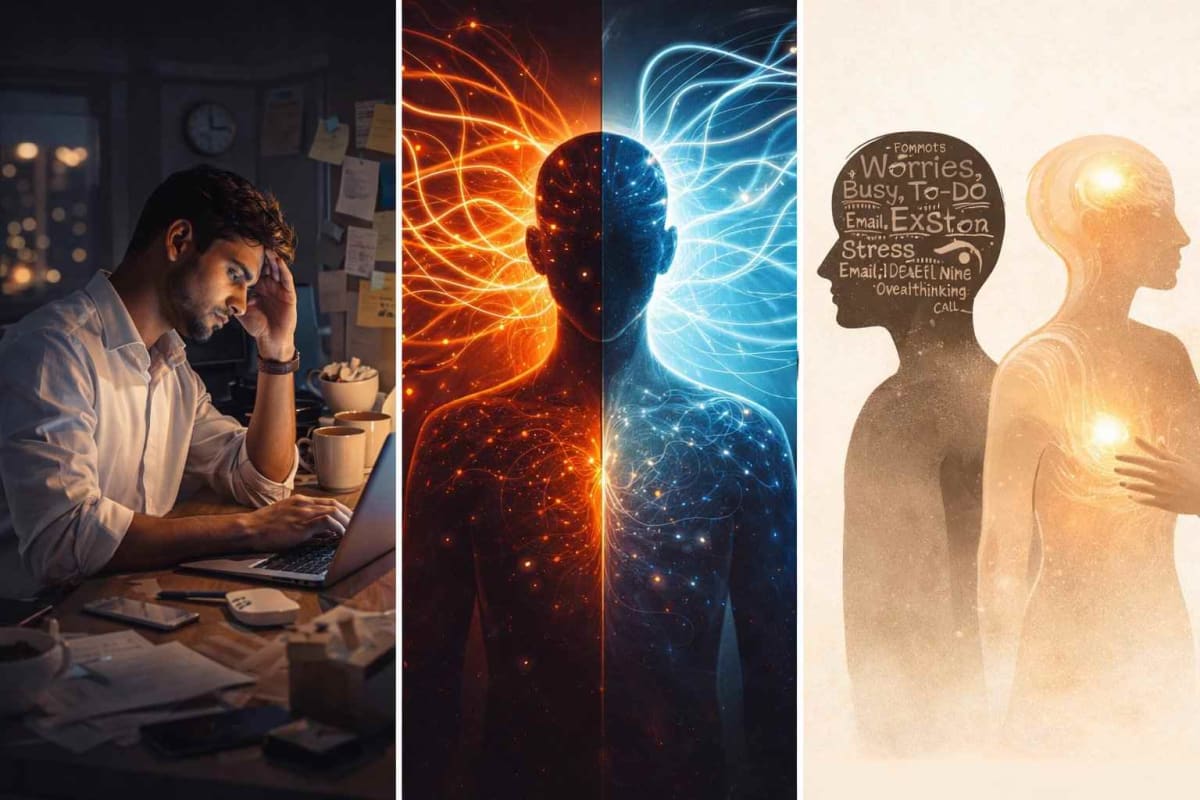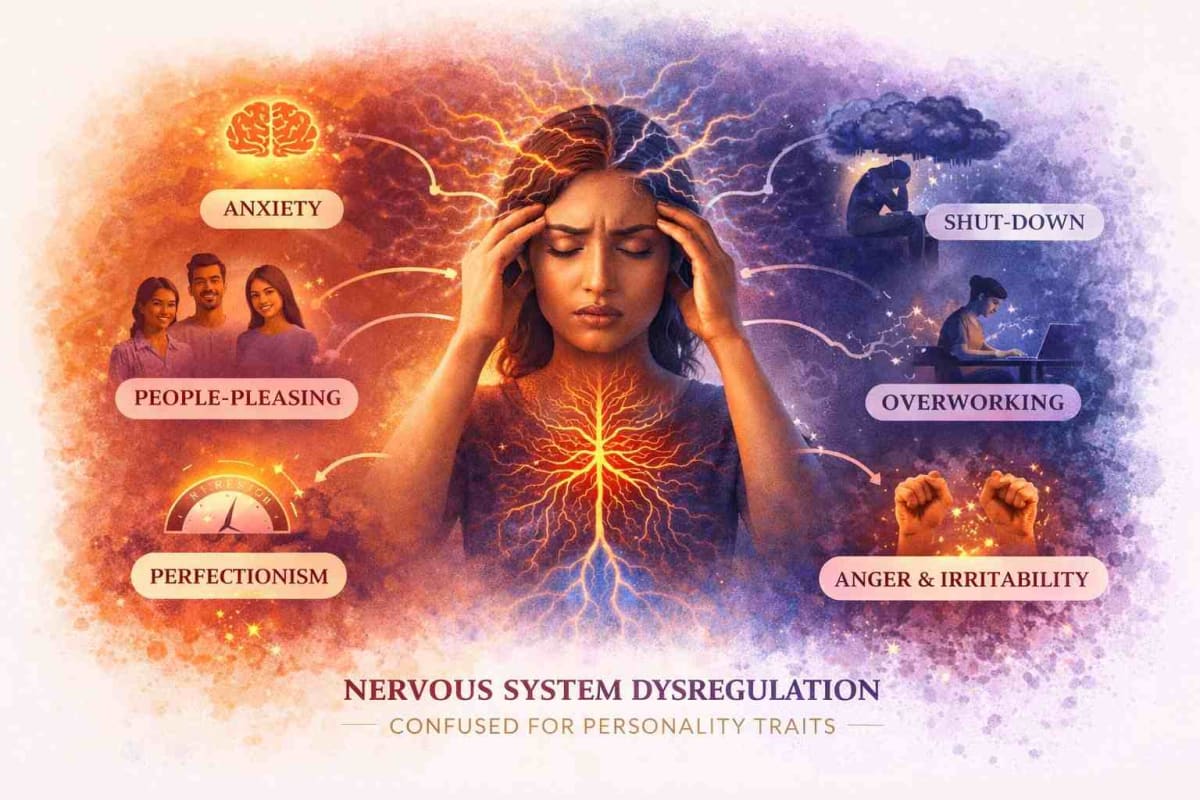
Signs Your Nervous System Is Dysregulated (And You've Mistaken It for Your Personality)
“Aditi Nirvaan identifies the specific signs of nervous system dysregulation that high-functioning adults consistently mistake for personality traits, and explains what is actually happening biologically.”
10 Signs Your Nervous System Is Dysregulated (And Why It Feels Like Your Personality)
Here is something I have noticed across 22 years of working with high-functioning adults.
The people who most need this information are often the ones least likely to believe it applies to them.
Because what I am about to describe does not look like a problem from the outside.
It looks like a certain kind of person.
Driven.
Capable.
Private.
Slightly intense.
Someone who holds a lot together.
Someone who delivers consistently.
Someone who manages well.
And over time, that person simply begins to believe:
“This is just who I am.”
But what if it is not?
What if a significant portion of what you think of as your personality is actually your nervous system stuck in a survival pattern it learned years ago?
A pattern repeated so consistently, for so long, that neither you nor anyone around you can distinguish it from identity anymore.
That is not a comfortable possibility.
It is also one of the most useful ones available.
Before the Signs: What Nervous System Dysregulation Actually Means
Your autonomic nervous system manages everything your body does automatically:
- Heart rate
- Digestion
- Sleep
- Immune response
- Breath
- The continuous scanning for safety or threat
When the system is regulated, it moves fluidly between activation and rest.
It mobilises when genuine demand exists and returns to baseline when the demand passes.
It is not permanently switched on.
And it is not permanently shut down.
When the system becomes dysregulated, that fluidity disappears.
It gets stuck.
Usually in one of two states:
- Chronic activation (fight-or-flight)
- Chronic shutdown (freeze or collapse)
Polyvagal Theory, developed by Dr. Stephen Porges, describes three primary nervous system states:
- Ventral vagal state — safety, connection, social engagement
- Sympathetic state — activation, mobilisation, threat response
- Dorsal vagal state — shutdown, numbness, collapse
Regulation is not permanently staying calm.
It is the ability to move fluidly between these states and return to safety when the threat is over.
Most chronically dysregulated people do not realise they are dysregulated.
They think:
- “I am just intense.”
- “I am naturally anxious.”
- “I have always been like this.”
But often what they are calling personality is physiology.
1. You Are Always Slightly On Guard — Even in Safe Situations
There is a low-grade vigilance running beneath most interactions.
Not paranoia.
Nothing dramatic.
Just a subtle scanning that never fully switches off.
You monitor:
- People's tone
- Micro-reactions
- The emotional atmosphere in a room
- Potential problems before they happen
Even at home, there is often a slight readiness in the body.
You may call this:
- Being responsible
- Being attentive
- Being highly aware
But physiologically, it is usually a sympathetic nervous system that never fully received the signal that the original threat is over.
2. Rest Does Not Restore You
You sleep.
Sometimes enough.
Sometimes not.
But the deeper issue is that rest does not land.
You wake up tired.
Vacations help briefly and then the familiar exhaustion returns.
A weekend doing nothing often creates anxiety instead of recovery.
This happens because genuine restoration requires the nervous system to enter deep parasympathetic states.
A chronically activated system struggles to fully access them.
The body goes through the mechanics of sleep without reaching the depth of restoration it actually needs.
This is not ordinary tiredness.
It is the exhaustion of a system that has not genuinely rested in years.
3. Small Things Irritate You More Than They Should
A tone of voice.
A delayed reply.
Someone being slightly late.
A minor inconvenience.
You know intellectually the reaction is disproportionate.
And that knowledge does not reduce the reaction.
Chronic activation lowers the nervous system's threshold for detecting threat.
The amygdala becomes hypersensitive.
Things a regulated system would dismiss as irrelevant get flagged as requiring response.
The irritability is rarely about the actual situation.
It is about a nervous system already operating at capacity.
4. You Struggle to Be Fully Present
There is often a subtle sense of being slightly elsewhere.
Even in important moments.
In conversations, part of you remains slightly removed.
Quiet moments feel uncomfortable.
Stillness creates restlessness.
Being alone without distraction produces unease.
This is not simply a focus issue.
It is a nervous system that has difficulty settling into the ventral vagal state where genuine presence becomes possible.
The system remains oriented toward scanning rather than arriving.
This is also why meditation can initially feel frustrating for chronically dysregulated people.
Stillness often amplifies what the system has been avoiding.
5. Your Body Holds Chronic Tension
The jaw.
The shoulders.
The chest.
The throat.
The lower abdomen.
Somewhere in the body there is a holding pattern that never completely releases.
You may have tried:
- Massage
- Yoga
- Stretching
- Physiotherapy
And while they help temporarily, the tension returns.
Because the tension is not merely muscular.
It is protective.
The nervous system learned to brace against something, and the body organised itself accordingly.
Until the nervous system receives the signal that the bracing is no longer necessary, the body will continue holding the pattern.
6. You Oscillate Between Intensity and Flatness
There are periods of:
- High productivity
- High focus
- High energy
And then sudden drops:
- Flatness
- Numbness
- Loss of motivation
- Difficulty caring about anything
This is often the nervous system moving between:
- Sympathetic activation
- Dorsal vagal shutdown
The intensity is mobilisation.
The flatness is collapse after prolonged activation.
Neither state is your personality.
Both are physiological adaptations.
7. Certain Emotions Feel Inaccessible
You know certain emotions should be there.
But they do not fully arrive.
Grief feels distant.
Joy feels muted.
Tenderness creates contraction instead of openness.
Anger leaks sideways instead of expressing cleanly.
In chronic activation, the system prioritises survival over emotional connection.
In shutdown, emotional experience itself gets turned down.
This is not emotional deficiency.
It is the nervous system protecting against emotional states that once felt unsafe.
8. Receiving Care Feels Uncomfortable
Compliments bounce off.
Help feels uncomfortable.
Rest creates guilt.
Being cared for produces subtle tension rather than relief.
You minimise praise.
Deflect support.
Reciprocate immediately instead of receiving.
The nervous system that learned safety through performance and self-management often experiences receptivity itself as threatening.
This is not independence as a value.
It is a survival adaptation repeated so long it became invisible.
9. People Describe You as Intense, Driven, or Hard to Reach
You are often described as:
- Intense
- Private
- Driven
- Self-sufficient
- Hard to read
Some of these qualities may genuinely belong to your character.
But chronic nervous system activation also creates a very specific interpersonal profile:
- Guardedness that looks like privacy
- Hyper-focus that looks like ambition
- Difficulty resting that looks like work ethic
- Emotional distance that looks like independence
These patterns feel permanent because they have existed for so long.
But they are not as fixed as they appear.
10. You Have Done Significant Personal Development Work — But Your Inner State Has Not Fundamentally Changed
This is the most important sign on this list.
You have:
- Read the books
- Done therapy
- Meditated
- Journaled
- Developed self-awareness
And despite genuine growth, there is still a baseline quality inside you that has not shifted.
A background hum of:
- Vigilance
- Flatness
- Anxiety
- Exhaustion
This is not a failure of effort.
It is a sign that the work has primarily happened at the level of thought and understanding while the dysregulation remains stored in the body and nervous system.
The nervous system does not update through insight alone.
It updates through embodied experience.
Through somatic processes working at the level where the pattern is actually held.
What This Is Not
Naming these signs is not about pathologising yourself.
Most of these patterns developed intelligently.
They were adaptive responses to real conditions.
The nervous system that learned vigilance was responding appropriately to environments that required vigilance.
The system that learned shutdown was protecting itself from overwhelm.
The question is not:
“Did my nervous system make a mistake?”
It did not.
The question is:
“Is the pattern that once protected me still the most useful one available now?”
In most cases, the original conditions have changed.
The nervous system simply has not updated yet.
And that update does not happen through willpower or understanding alone.
It happens through a somatic, trauma-informed, expert-held process working directly with the body and nervous system.
Where This Work Begins
The 3 Hour Shadow Work Masterclass (Live) addresses both:
- The somatic reality of nervous system dysregulation
- The unconscious shadow and karmic patterns sustaining it
This is not stress management.
It is structured, expert-held work designed to meet the pattern where it actually lives:
- In the body
- In the nervous system
- In unconscious impressions shaping your life from beneath awareness
Book your place in the Shadow Work Masterclass
And if you want to understand the specific karmic pattern beneath your nervous system dysregulation, the Destiny Map™ session is where that precise identification begins.

Written by
Aditi Nirvaan
India's Only IPHM Accredited Shadow Work Expert, TEDx Speaker, and creator of Shadow Mapping™, NeuroSomatic Breathwork™ & Destiny Map™. Featured in Vogue India, Times of India, Mid-Day & Life Positive.