Breathwork vs. Meditation: What Science Says and What Your Body Actually Needs
“Aditi Nirvaan explains the precise difference between breathwork and meditation, what the latest research actually shows, and how to know which practice your body actually needs right now.”
Meditation vs Breathwork: Why One Calms the Mind and the Other Changes the Nervous System
Most people who eventually find their way to breathwork have already tried meditation.
Often sincerely.
Sometimes for years.
They used the apps.
Attended the classes.
Sat every morning for twenty minutes because someone said consistency would change everything.
And they experienced real benefits:
- Moments of calm
- Greater clarity
- A more spacious relationship with thought
But eventually many noticed something important.
The calm lasted during the practice and briefly afterward.
The deeper patterns underneath:
- The background vigilance
- The chronic tension
- The recurring emotional cycles
- The nervous system bracing
Remained largely unchanged.
The meditation was working.
And still, something deeper was not moving.
This article is about that difference:
- What meditation actually does
- What it does not do
- And why somatic breathwork reaches layers many people cannot access through meditation alone
What Meditation Actually Does
Meditation, in its most well-researched forms, is fundamentally a practice of trained attention.
Whether the focus is:
- The breath
- A mantra
- A visualisation
- Open awareness
The core mechanism remains the same:
The practitioner repeatedly returns conscious attention to a chosen object.
Over time, this develops:
- Greater attentional stability
- Reduced reactivity
- Improved emotional regulation
- More spaciousness around thought
The neuroscience behind meditation is real and substantial.
Regular meditation practice has been associated with measurable changes in:
- Grey matter density
- Prefrontal cortex function
- Amygdala reactivity
- Stress response regulation
Research consistently shows meaningful benefits for:
- Stress reduction
- Focus
- Cognitive flexibility
- Emotional awareness
For many people, meditation is genuinely transformative.
At the level it is designed to work.
What Meditation Does Not Do
This is where the conversation becomes more nuanced.
Meditation is primarily a top-down practice.
Conscious attention is used to gradually influence:
- The body
- The emotions
- The nervous system
The movement begins with awareness.
And over time, awareness shapes physiology.
This approach has real power.
But it also has limits.
Because many deeply conditioned patterns:
- Trauma imprints
- Survival adaptations
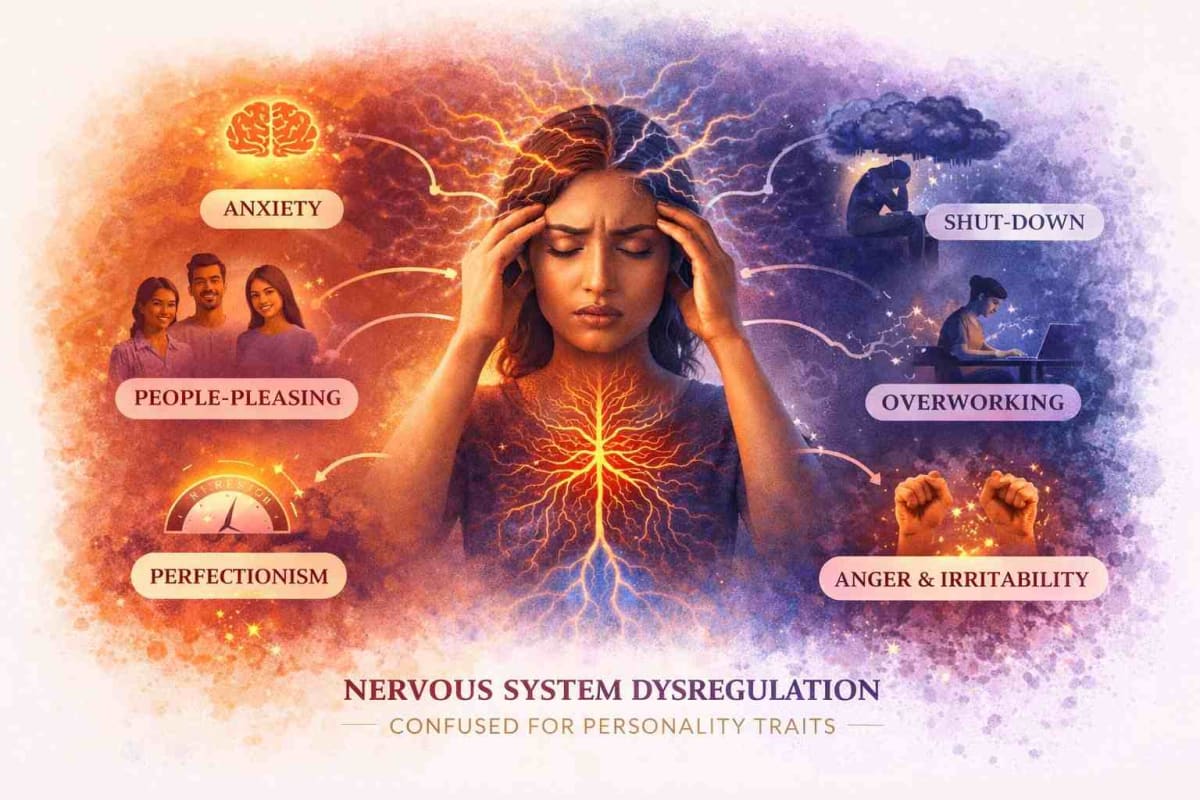
- Chronic nervous system responses
- Samskaras stored in the body
Operate below the level of conscious attention.
They are not stored primarily as thoughts.
They are stored physiologically:
- In the nervous system
- In muscular contraction
- In breath restriction
- In autonomic survival responses
This is why many people meditate sincerely for years and still find:
- The relationship pattern remains
- The nervous system still braces
- The body still carries chronic tension
- The deeper emotional reactions remain largely unchanged
The meditation is not failing.
It is simply working at a different level than the material being held.
When Meditation Can Actually Intensify Dysregulation
This is rarely discussed openly.
But it matters.
For people carrying significant trauma or chronic nervous system dysregulation, meditation can sometimes intensify activation rather than reduce it.
Because asking a dysregulated nervous system to sit still and observe itself can surface material the body is not yet equipped to process safely.
The practitioner may experience:
- Anxiety
- Overactivation
- Depersonalisation
- Emotional flooding
- Traumatic material surfacing without integration
This does not mean meditation is harmful.
It means meditation is not universally the correct first intervention for every nervous system.
Especially in people carrying significant somatic charge beneath conscious awareness.
What Breathwork Does Differently
The breath occupies a unique position in human biology.
It is the only autonomic function that is both:
- Automatic
- Consciously controllable
You cannot consciously control:
- Your digestion
- Your immune system
- Your heart rhythm directly
But you can consciously alter your breathing.
This makes the breath a direct access point into the autonomic nervous system itself.
By changing breathing patterns, it becomes possible to directly influence:
- Sympathetic activation
- Parasympathetic regulation
- Vagal tone
- Physiological safety states
And this changes everything.
Because somatic breathwork works bottom-up.
The body changes first.
The conscious mind follows.
The Difference Between Top-Down and Bottom-Up Work
This distinction explains almost everything.
Meditation
Works top-down.
Awareness influences physiology gradually through sustained attention.
Excellent for:
- Attention training
- Cognitive flexibility
- Emotional spaciousness
- Reduced mental reactivity
Somatic Breathwork
Works bottom-up.
The breath directly changes the physiological state of the nervous system.
This allows:
- Stored survival responses to surface
- Somatic material to move
- Nervous system states to reorganise
- Trauma imprints to begin integrating physiologically
For material stored below conscious awareness, bottom-up work is often necessary.
Not because meditation lacks value.
Because the body sometimes needs direct physiological intervention before awareness alone can fully help.
Why Breathwork Often Creates Faster Change
Research increasingly supports what practitioners have observed clinically for years.
Conscious breathing practices can produce rapid effects on:
- Stress hormones
- Heart rate variability
- Executive function
- Sleep quality
- Autonomic nervous system regulation
Especially when compared to meditation alone over short periods.
The reason is straightforward:
Breathwork is working directly with the physiology generating the emotional state.
Not only the thoughts associated with it.
The Indian Context: Why This Matters Here Differently
India has one of the world’s deepest contemplative traditions.
Meditation, yoga, and spiritual stillness are culturally respected in ways rarely seen elsewhere.
That inheritance is valuable.
But it also creates a subtle blind spot.
Indian culture often privileges transcendence over embodiment.
The spiritually evolved person is imagined as:
- Still
- Detached
- Calm
- Above emotional turbulence
Meanwhile:
- Grief
- Rage
- Somatic release
- Nervous system discharge
Can be misunderstood as regression rather than integration.
The result is that enormous amounts of body-held material remain unresolved.
Especially in high-functioning Indian adults carrying:
- Multigenerational conditioning
- Performance pressure
- Emotional suppression
- Complex family systems
Breathwork, when trauma-informed and clinically held, reaches these layers directly.
Not instead of meditation.
Alongside and beneath it.
So Which Practice Does Your Body Actually Need?
Meditation May Be the Right Primary Practice If:
- You are relatively regulated already
- You do not carry significant unresolved trauma
- You want to strengthen attentional capacity
- You are building a contemplative or spiritual practice
- You primarily want greater spaciousness around thought and emotion
Somatic Breathwork May Be the Better Starting Point If:
- Meditation increases activation rather than settling
- You carry chronic nervous system dysregulation
- You have significant trauma history
- You feel disconnected from your body
- The deep patterns remain unchanged despite years of inner work
- Your body holds chronic tension meditation has not shifted
Both Together Often Create the Deepest Change
Meditation develops:
- Awareness
- Observation
- Presence
Somatic breathwork develops:
- Embodied regulation
- Nervous system integration
- Release of held survival responses
Together, they create something neither practice alone fully offers:
The ability to meet deep material with both:
- Conscious awareness
- Embodied capacity
Not All Breathwork Is the Same
This distinction matters enormously.
Breathwork used for:
- Stress reduction
- Quick nervous system resets
- Energy activation
Can be genuinely useful.
But breathwork as a clinical somatic methodology is different entirely.
Working with:
- Trauma imprints
- Samskaras
- Chronic dysregulation
- Body-held survival responses
Requires:
- Trauma-informed facilitation
- Somatic nervous system tracking
- Careful pacing
- Proper integration
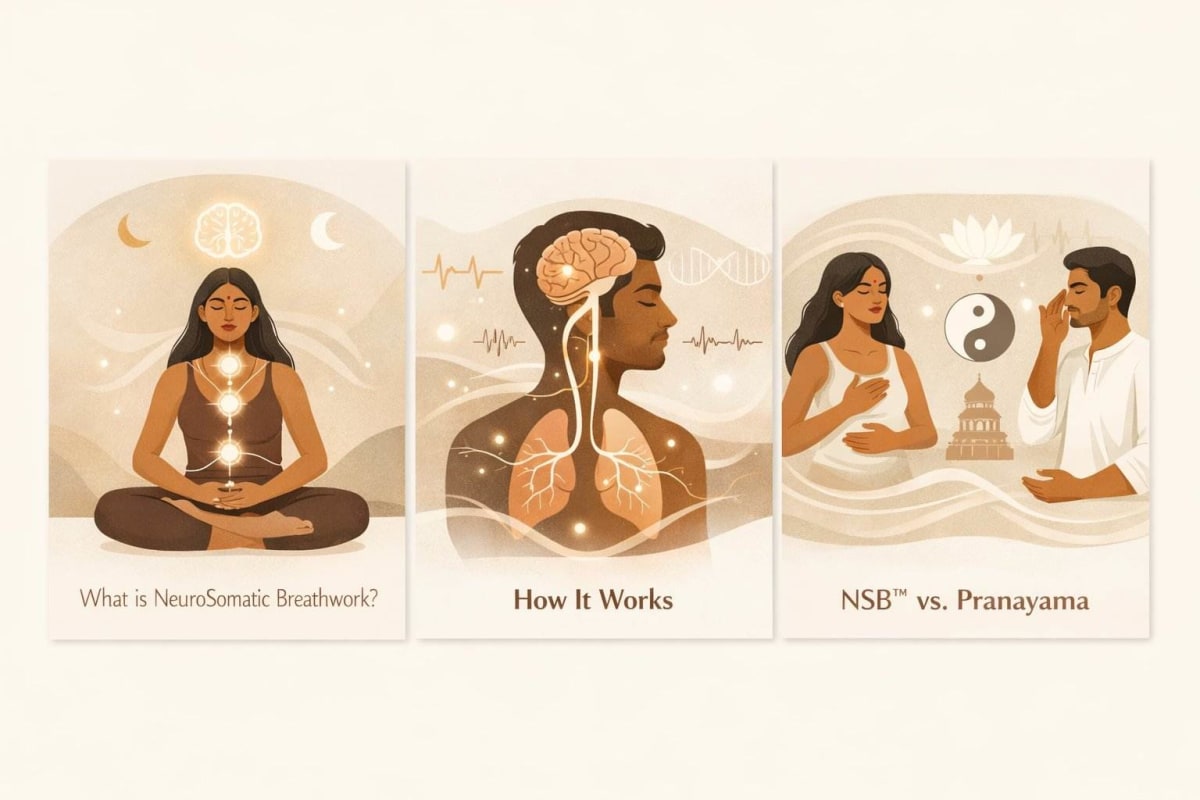
NeuroSomatic Breathwork™ was developed specifically for this level of work.
Not as wellness optimisation.
But as a clinical somatic methodology for material traditional practices often cannot fully reach.
Where This Work Begins
If you have been meditating sincerely and still feel the deeper patterns have not shifted, the 3 Hour Shadow Work Masterclass (Live) is the clearest entry point into the somatic and nervous system work your body may actually need.
It is:
- Trauma-informed
- Clinically structured
- Built on NeuroSomatic Breathwork™ and Shadow Mapping™
- Designed specifically for nervous system integration
Book your place in the Shadow Work Masterclass
And if you want to identify the specific karmic pattern sustaining the material your meditation has been circling for years, the Destiny Map™ session is where that deeper identification begins.
Aditi Nirvaan is India’s Only IPHM Accredited Shadow Work Expert, TEDx speaker, and creator of Shadow Mapping™, NeuroSomatic Breathwork™, and the Destiny Map™. Over the last 22 years, she has guided more than 50,000 people across India and internationally through trauma-informed shadow work, nervous system integration, and somatic transformation.

Written by
Aditi Nirvaan
India's Only IPHM Accredited Shadow Work Expert, TEDx Speaker, and creator of Shadow Mapping™, NeuroSomatic Breathwork™ & Destiny Map™. Featured in Vogue India, Times of India, Mid-Day & Life Positive.