What Is Nervous System Regulation and Why Every High-Performer Needs It
“Aditi Nirvaan explains what nervous system regulation actually is, what dysregulation looks like in high-functioning adults, and why somatic work rather than mindset shifts is what produces genuine change.”
Nervous System Regulation: Why High-Functioning Adults Still Feel Exhausted, Anxious, and Stuck
There is a version of high performance that looks, from the outside, completely fine.
The deadlines are met. The presentations land. The leadership is steady.
The family sees someone who is managing well.
The colleagues see someone who has it together.
And the person inside all of that sees something different entirely.
The sleep that never quite restores.
The decisions that take more effort than they should.
The irritability that arrives without warning.
The feeling of being simultaneously exhausted and unable to switch off.
Grazia India named this the defining condition of 2026:
The era of great exhaustion.
It is not a mindset problem.
It is not a time management problem.
It is a nervous system problem.
And it will not be solved by another productivity system, another morning routine, or another meditation app.
What the Nervous System Actually Does
The autonomic nervous system is the part of your biology that manages everything you do not consciously control.
- Your heart rate
- Your digestion
- Your immune response
- Your breath
- Your sleep cycles
- Your stress response
- Your capacity for connection, creativity, and clear thinking
It operates through two primary branches:
- The sympathetic nervous system — which activates the body for action, mobilising energy and preparing the system to respond to threat or demand
- The parasympathetic nervous system — which returns the body to rest, digestion, repair, and restoration after the demand has passed
A regulated nervous system moves fluidly between these two states.
It activates when activation is required and returns to rest when the demand has passed.
It is not permanently switched on.
It is not permanently switched off.
It responds to what is actually happening rather than to a threat that ended years ago but was never fully processed.
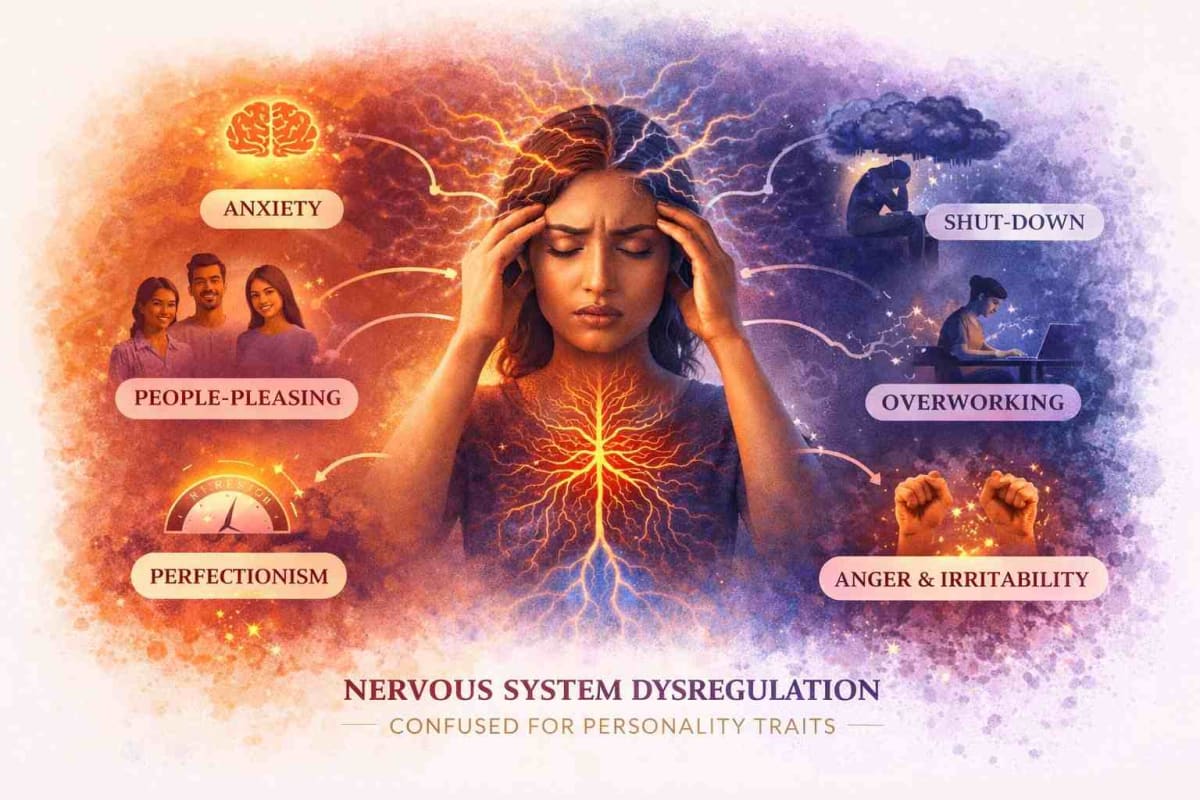
A dysregulated nervous system does not have that fluidity.
It gets stuck.
Either in chronic activation — where the stress response runs continuously regardless of whether a real threat is present — or in chronic shutdown, where the system has used so much energy managing chronic stress that it has simply gone flat.
Both states look functional from the outside for a long time.
Neither is.
What Dysregulation Actually Looks Like
This is where the conversation tends to get either too clinical or too vague, and I want to be specific.
Chronic Sympathetic Activation (The Stuck-On State)
This looks like:
- Persistent low-grade anxiety with no single identifiable cause
- Sleep that does not restore
- Hair-trigger irritability
- The inability to be genuinely present
- Constant internal scanning for threat
- Decisions feeling more effortful than they should
When the threat response is running, the prefrontal cortex — the part of the brain responsible for complex reasoning — is partially offline.
Chronic Dorsal Vagal Shutdown (The Stuck-Off State)
This looks different.
- Flatness
- Emotional numbness
- Disconnection from the body
- Fatigue that does not respond to rest
- A sense of watching your own life from a slight distance
This state is often mistaken for depression.
And while it can produce depressive symptoms, it is a distinct physiological state with its own specific signature.
Many high-functioning adults carry both simultaneously, oscillating between them in ways that feel confusing and exhausting.
- Wired at night, flat in the morning
- Highly reactive at work, numb at home
- Capable of enormous output followed by crashes that take longer and longer to recover from
Why High-Performers Are Particularly Vulnerable
There is a specific way that high-performance culture creates and sustains nervous system dysregulation.
High performers, by definition, have developed extraordinary capacity to function under pressure.
They have learned — usually from early in life — to override the signals their nervous system sends.
- To push through fatigue
- To manage anxiety rather than address it
- To keep delivering regardless of what is happening internally
This capacity is real.
It is also deeply costly over time.
The nervous system responds to chronic override the same way any system responds to chronic overload:
- The threshold for what counts as a threat lowers
- The baseline level of activation rises
- The capacity for genuine rest and recovery diminishes
What was once an extraordinary ability to function under pressure eventually becomes a system that cannot find its way back to regulation even when the pressure is gone.
Research published in 2026 found that the leaders who sustain performance through volatility are not the most disciplined.
They are the most regulated.
Higher heart rate variability — a measurable indicator of nervous system regulation — is directly associated with:
- Better executive functioning
- Emotional regulation
- Cognitive flexibility under pressure
The performance edge high performers are trying to protect by pushing harder is often being eroded by the pushing itself.
The Indian Context
In India, this dynamic has a particular texture.
The culture of high performance in Indian professional environments carries specific pressures that compound nervous system load in ways that are not always visible as stress.
The intersection of:
- Professional ambition
- Family obligation
- Being the first in the family to achieve a certain level
- The expectations attached to success
- The social visibility that achievement brings in Indian communities
These are not abstract pressures.
They are daily, embodied, relentless, and rarely acknowledged as the nervous system load they actually are.
WGSN predicted 2026 as the year of great exhaustion.
Grazia India described the cultural shift from “self-care routines” toward the idea of the nervous system reset.
A growing recognition that what people are experiencing is not manageable through better habits alone.
What I have observed across 22 years of working with high-functioning Indian adults is this:
A significant proportion of what presents as:
- Professional stagnation
- Creative block
- Relationship difficulty
- Recurring self-sabotage patterns
Is rooted not in a thinking problem, but in a nervous system problem.
The system is either too activated or too depleted to access the full range of cognitive and emotional resources the person actually has.
What Nervous System Regulation Is Not
This needs to be said clearly, because the term is everywhere right now.
Nervous system regulation is not relaxation.
You can be deeply relaxed in a shutdown state, which is not regulation.
You can appear calm while running a chronic low-grade threat response, which is also not regulation.
It is not a breathing exercise you do for five minutes when stressed.
Breathing exercises can support regulation.
But they are surface interventions for surface states.
They do not address the deeper patterns generating the dysregulation.
It is not a mindset shift.
The nervous system operates below conscious thought.
You cannot think your way into regulation.
The body needs a different experience, not a different belief.
And it is not something that happens quickly for people who have been dysregulated for years.
The system learned its current pattern through repeated experience over decades.
Genuine regulation requires a sustained, body-based, properly supported process of relearning.
What Genuine Nervous System Regulation Requires
Polyvagal Theory, developed by Dr. Stephen Porges, gives us one of the most useful contemporary maps for understanding how the nervous system functions in relationship to safety, threat, and connection.
The theory describes three primary states:
- Ventral vagal state — safety, connection, and social engagement
- Sympathetic state — mobilisation and threat response
- Dorsal vagal state — shutdown and collapse
Regulation is not permanently staying in the ventral vagal state.
It is the ability to move fluidly between states and return to safety once the demand has passed.
Building that capacity requires three things.
1. Somatic Awareness
The ability to feel what is happening in the body in real time.
Most high performers have spent years overriding bodily signals rather than reading them.
Rebuilding awareness is the first step.
2. Somatic Intervention
Body-based practices that directly shift the physiological state.
Working with:
- The breath
- Posture
- Movement
- Interoception
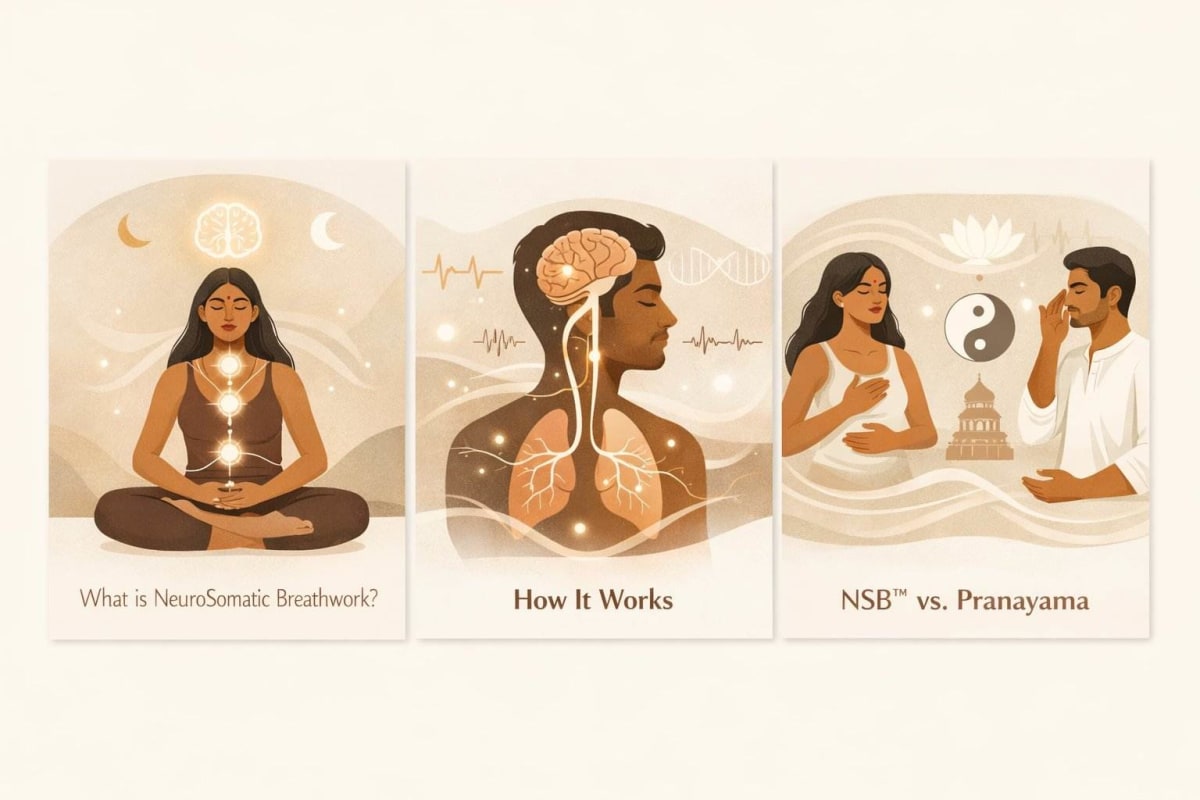
NeuroSomatic Breathwork™ is the methodology I developed over 22 years specifically for this purpose.
It is not relaxation breathwork.
It is a clinical somatic methodology that works directly with the nervous system at the level where dysregulation is held.
3. Working With the Root of the Dysregulation
Most chronic nervous system dysregulation in high-functioning adults is not simply the product of current stress.
It is the product of samskaras — unconscious karmic impressions formed through significant early experiences.
The nervous system learned, very early, that certain conditions were unsafe.
And it has been running that learning ever since, whether or not the original conditions still exist.
Breathwork and somatic practices can build real capacity for regulation.
But if the underlying samskaras are not identified and integrated, regulation becomes ongoing maintenance rather than structural change.
This is the difference between:
- Nervous system management
- Nervous system healing
What Changes When the Nervous System Regulates
The changes are not subtle.
And they are not limited to stress reduction.
Cognitive Clarity Returns
The prefrontal cortex becomes more fully available.
Decision-making becomes less effortful.
The ability to:
- Think strategically
- Hold complexity
- See multiple perspectives
- Respond rather than react
All improve as baseline threat activation reduces.
Emotional Range Expands
Not just in the direction of calm.
In every direction.
The numb person begins to feel again.
The reactive person develops space between stimulus and response.
The full range of relational and creative capacity becomes available.
Sleep Changes
Not overnight.
But over time, the quality of rest improves as the system learns to genuinely enter restorative states.
Recurring Patterns Begin to Shift
The patterns that looked like personality, bad luck, or habit begin to reveal themselves as physiological responses.
And that visibility creates the possibility of genuine change.
Where This Work Begins
The 3 Hour Shadow Work Masterclass (Live) is the most direct entry point into this work that I offer.
It addresses the somatic and shadow dimensions of the patterns sustaining dysregulation.
Working at the level where those patterns are actually held:
- In the body
- In the nervous system
- In unconscious impressions that have been running the show
It is not a stress management workshop.
It is structured, expert-held somatic work designed for high-functioning adults ready to address the root rather than continue managing symptoms.
Book your place in the 3 Hour Shadow Work Masterclass
And if you want to understand the specific karmic pattern beneath your nervous system dysregulation, the Destiny Map session is where that precise identification begins.

Written by
Aditi Nirvaan
India's Only IPHM Accredited Shadow Work Expert, TEDx Speaker, and creator of Shadow Mapping™, NeuroSomatic Breathwork™ & Destiny Map™. Featured in Vogue India, Times of India, Mid-Day & Life Positive.