How to Break a Karmic Pattern (Without Astrology or Prediction)
“Aditi Nirvaan explains what actually breaking a karmic pattern requires, why prediction and astrology cannot do it alone, and the somatic, shadow-informed process that produces structural change.”
Can Astrology Break a Karmic Pattern? Why Insight Alone Does Not Change the Cycle
You have probably had at least one good Vedic astrology reading.
Maybe more than one.
Maybe you sat across from a Jyotishi who described your chart with remarkable precision.
The timing felt uncanny.
The description of your nature felt accurate.
You left feeling understood in a way that is genuinely rare.
And then the pattern continued.
The same relationship dynamic with a different person.
The same financial ceiling with a different strategy.
The same moment of pulling back right before something meaningful happens — again, and again, and again — while fully aware you are doing it.
This article is for that experience.
The experience of having the pattern identified clearly and still finding yourself inside it.
The Difference Between Knowing a Pattern and Breaking One
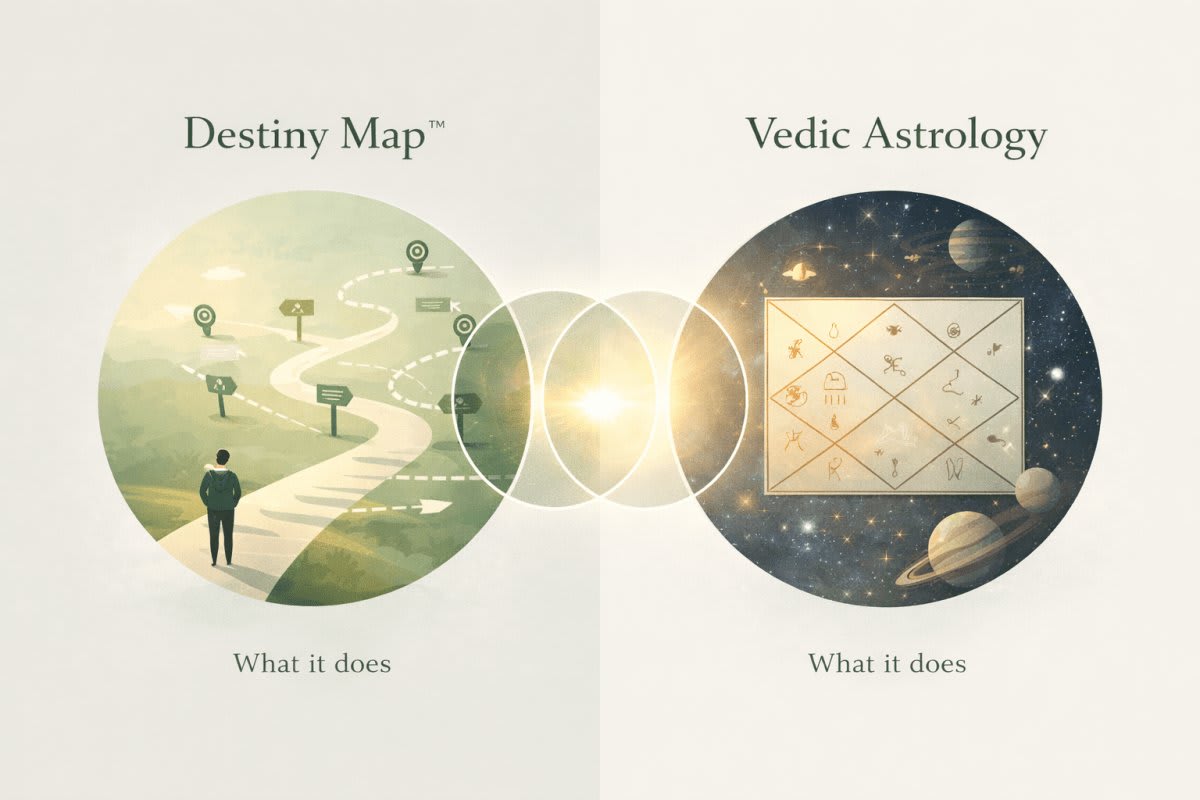
Astrology, at its best, is an extraordinary system for understanding the terrain of your life.
A skilled Jyotishi can identify:
- Karmic tendencies
- Planetary periods
- Recurring themes
- Likely challenges and strengths
This is deeply valuable.
But it is not the same thing as breaking the pattern itself.
Knowing that Saturn in the seventh house correlates with recurring relationship difficulty does not automatically change the nervous system response activated every time intimacy deepens.
Knowing that Rahu influences your relationship with money does not dissolve the unconscious fear and contraction around worthiness formed through early childhood experiences.
The map describes the terrain.
It does not transform it.
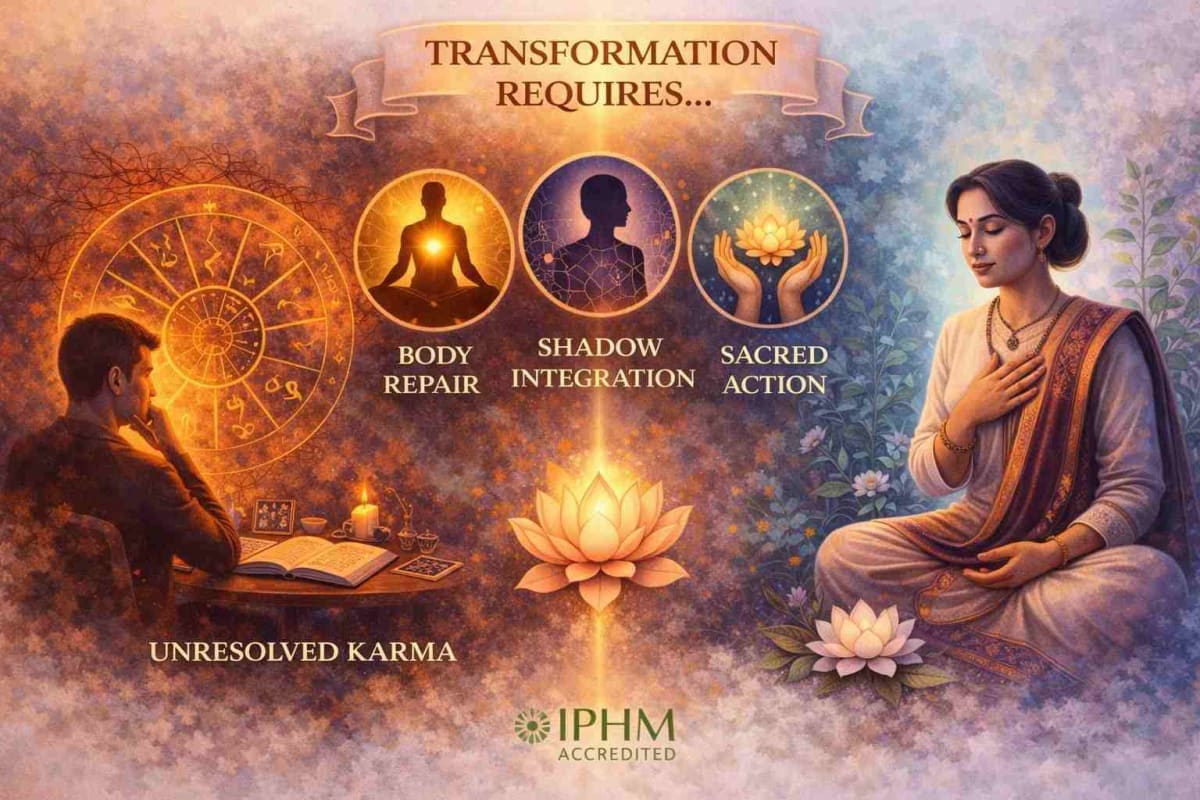
Breaking a karmic pattern requires working at an entirely different level:
- The body
- The nervous system
- The unconscious impressions generating the pattern beneath awareness
This is what the Vedic tradition actually points toward when speaking about karma and liberation.
Not prediction alone.
Integration.
What a Karmic Pattern Actually Is
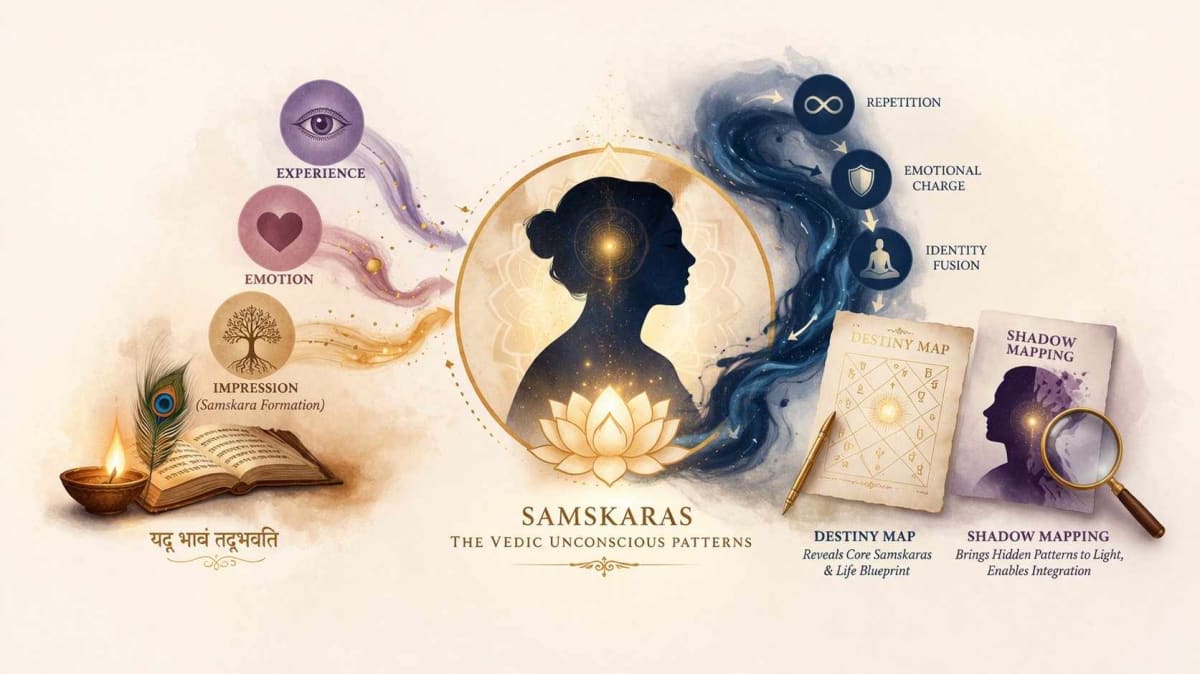
The Vedic tradition has a precise word for what most people loosely call karmic patterns:
Samskara.
A samskara is a karmic impression formed through significant experience and stored within the field of consciousness and memory.
It operates beneath awareness, predisposing a person toward specific reactions, choices, and emotional responses.
A samskara is not punishment.
It is not evidence you “did something wrong” in a past life.
It is the nervous system doing exactly what it was designed to do:
Using previous experience to predict and respond to future conditions.
The difficulty is that most samskaras formed early.
Often under conditions very different from the ones you live in now.
The samskara around abandonment formed at four years old still activates protective responses in adult relationships.
The samskara around money formed through witnessing instability at age seven still generates anxiety around receiving or expansion decades later.
The pattern is not irrational.
It is loyal.
It simply never received the signal that the original conditions have changed.
Modern neuroscience describes the same mechanism through conditioned neural pathways.
Emotionally significant experiences create automatic responses operating below conscious awareness.
The Vedic description of samskaras and the neuroscientific description of conditioning are describing the same underlying reality through different languages.
Why Prediction Does Not Break the Pattern
This is where many people become frustrated.
The astrology reading was accurate.
The timing was correct.
The pattern was identified precisely.
And the pattern is still running.
This is not a failure of astrology.
It is confusion about what astrology is designed to do.
Prediction describes what is likely given the current karmic configuration.
It does not alter that configuration.
Knowing that a particular planetary period intensifies relationship difficulty does not dissolve the unconscious relational pattern itself.
Awareness helps.
Preparation helps.
Perspective helps.
But awareness is not integration.
The Vedic tradition itself distinguishes between:
- Prarabdha karma — karma currently active and producing results
- Agami karma — karma being generated through present choices and responses
The chart can describe Prarabdha karma with remarkable precision.
But unless the unconscious samskaras driving present responses are integrated, the same patterns continue recreating themselves.
This is why prediction alone does not produce transformation.
What Actually Breaks a Karmic Pattern
After 22 years of working directly with samskaras and unconscious patterns, I have found three things consistently necessary for genuine structural change.
1. The Pattern Must Be Identified Precisely
Most people already know their pattern in general terms.
They know they struggle with:
- Intimacy
- Visibility
- Money
- Authority
- Receiving
That awareness often exists for years without changing anything.
What creates movement is precise identification:
- Where the samskara formed
- What it protects
- What it costs
- How it activates somatically
- What the nervous system does when it activates
This level of clarity rarely emerges through self-analysis alone.
The unconscious cannot fully see itself from inside itself.
That is not failure.
It is the nature of unconscious patterning.
2. The Work Must Happen Somatically
This is the most important and most overlooked part.
Samskaras are not stored primarily in thought.
They are held in:
- The body
- The nervous system
- Breath patterns
- Postural contractions
- Autonomic responses
Cognitive insight changes your understanding of the pattern.
It does not automatically change the pattern itself.
Somatic neuroscience is extremely clear on this:
Conditioned nervous system patterns require embodied intervention.
The body needs a different experience, not simply a different explanation.
This is why NeuroSomatic Breathwork™ is central to my methodology.
Not as relaxation.
Not as stress management.
But as a precise somatic process working directly with the nervous system where the samskara actually lives.
3. The Pattern Must Be Integrated, Not Managed
There is an enormous difference between:
- Managing a pattern
- Integrating a pattern
Managing
You become aware enough to interrupt the response before it fully plays out.
This creates improvement.
But the underlying samskara remains intact.
The activation still occurs.
The effort remains ongoing.
Integrating
The underlying imprint itself changes.
The charge stored in the samskara moves.
The protective response no longer activates compulsively.
The person does not need constant management because the structure generating the pattern has genuinely shifted.
This is what real karmic integration looks like.
The Missing Piece: The Shadow
Most karmic patterns also contain shadow material.
The samskara creates not only a behavioural pattern, but a shadow:
The parts of self pushed underground to survive the original conditions.
The child who experienced instability often suppresses:
- Need
- Anger
- Desire
- Authentic emotional expression
The samskara becomes the groove.
The shadow becomes everything buried to maintain it.
This is why genuine karmic integration almost always requires shadow work alongside somatic work.
Not instead of it.
Alongside it.
When both the samskara and the shadow are addressed together, the change becomes structural rather than temporary.
The Indian Context
In India, karma is often misunderstood as something to simply endure.
Or something resolved solely through ritual, devotion, or passive acceptance.
The Vedic tradition itself offers a far more nuanced understanding.
The Bhagavad Gita is fundamentally a teaching about conscious participation with one’s karmic configuration rather than unconscious submission to it.
Karma is not a sentence.
It is a current configuration.
And configurations can change.
Not through prediction alone.
But through direct embodied work with the samskaras themselves.
This is not a Western reinterpretation.
The Yoga Sutras of Patanjali explicitly describe working with samskaras through sustained awareness, disciplined practice, and release of outdated conditioning.
The methodology I developed over 22 years integrates these Vedic foundations with:
- Somatic neuroscience
- Trauma-informed practice
- Nervous system regulation
- Clinical transformational work
What This Process Actually Looks Like
The Destiny Map™ session is where this work begins for most people.
It is not predictive astrology.
It is a structured, one-on-one process identifying the specific samskara most active in your life right now.
Not generally.
Precisely.
We identify:
- Where the pattern formed
- What it protects
- What it costs
- How it operates somatically
- What the nervous system does when it activates
That visibility itself begins shifting the unconscious structure.
Because patterns lose part of their compulsive force once they become fully conscious.
From there:
- NeuroSomatic Breathwork™ works directly with the somatic imprint
- Shadow Mapping™ integrates the shadow material surrounding the samskara
Together, the process works from every direction simultaneously.
Not producing temporary insight.
Producing structural transformation.
Where This Work Begins
If you are ready to work at the level where karmic patterns are actually held — not merely described — the Destiny Map™ session is the right place to begin.
And if you want to work directly with the shadow material connected to those patterns, the 3 Hour Shadow Work Masterclass (Live) is where that deeper process begins.

Written by
Aditi Nirvaan
India's Only IPHM Accredited Shadow Work Expert, TEDx Speaker, and creator of Shadow Mapping™, NeuroSomatic Breathwork™ & Destiny Map™. Featured in Vogue India, Times of India, Mid-Day & Life Positive.